Journal of Indentureship and its Legacies
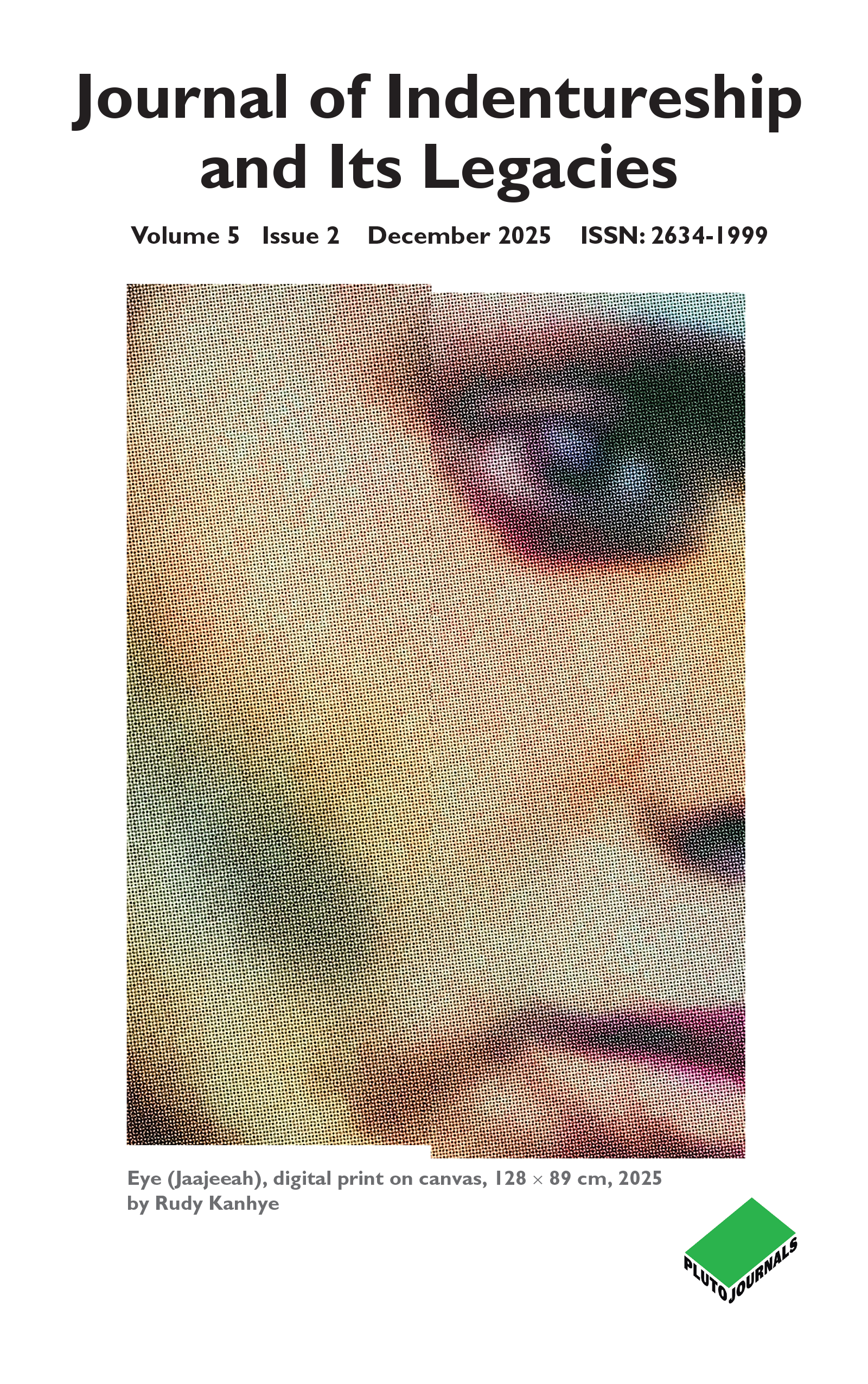
The Journal of Indentureship and its Legacies, exists to create a unique and unprecedented academic space where the study of indentureship, as a distinct form of unfree labour, can be analysed in all its forms. The Journal is peer reviewed and published bi-annually. No such Journal currently exists anywhere in the world, in spite of the critical importance of indentureship to world history.
Print ISSN: 2634-1999
Online ISSN: 2634-2006

The Journal of Indentureship and its Legacies is a unique and unprecedented academic space where the study of indentureship, as a distinct form of unfree labour, can be analysed in all its forms. No such Journal currently exists anywhere in the world, in spite of the critical importance of the system of indenture to world history.
The Journal is published twice a year, in June and December.
The Journal of Indentureship and its Legacies is published by Pluto Journals, which itself is part of the Pluto Educational Trust (PET)’s publishing network. Pluto Educational Trust (PET) is a UK-registered charity and network that supports independent publishing and educational projects aimed at social justice and critical scholarship.
There is active collaboration on the Journal of Indentureship and its Legacies between Pluto Journals and the Ameena Gafoor Institute for the Study of Indentureship and its Legacies, which is an educational initiative under PET, that aims to promote research and dialogue on indentureship. Pluto Journals is the publisher of the Journal of Indentureship and its Legacies. Meanwhile, the Ameena Gafoor Institute for the Study of Indentureship and its Legacies, under PET, provides the institutional foundation, through Pluto Journals, for the journal to be produced and disseminated. David Dabydeen is one of the founding members of the Ameena Gafoor Institute for the Study of Indentureship and its Legacies.
The Journal publishes both academic essays on and creative responses (fiction or poetry) to the study of indentureship. The academic study of indentureship occurs under a number of disciplines (history, geography, language, linguistics, music and sociology), accordingly the Journal publishes pieces in this multi-disciplinary spirit.
Editors
David Dabydeen (Emeritus, University of Warwick, UK)
Maria del Pilar Kaladeen (University of London, UK)
Amar Wahab (York University, Canada)
Advisory Board
Grace Aneiza Ali, New York University, USA
Gaiutra Bahadur, Rutgers University, USA
Eddie Bruce-Jones, Birbeck College, London University, UK
Ajay Chhabra, Independent Researcher
Richard Fung, OCAD University, Canada
Andil Gosine, York University Toronto, Canada
Betty Govinden, alumna, University of Kwa-Zulu Natal, South Africa
Moon-Ho Jung, University of Washington, USA
Aliyah Khan, University of Michigan, USA
Shivanjani Lal, Independent Researcher
Brij Lal, The Australian National University, Australia
Anne-Marie Lee-Loy, Ryerson University, Canada
Paloma Martin, University of Guyana, Guyana
Heidi Safia Mirza, University of London, UK
Nalini Mohabir, Concordia University, Canada
Patricia Mohammed, University of the West Indies, Jamaica
Satendra Nandan, University of Canberra, Australia
Rajrani Gobin, Mahatma Gandhi Institute, Mauritius
Ken Ramchand, University of the West Indies, Jamaica
Tina Ramnarine, Royal Holloway College, London University, UK
Brinsley Samaroo, University of the West Indies, Jamaica
Nur Sobers-Khan, British Library, UK
Janet Steel, Commonwealth International
Stephanos Stephanides, University of Cyprus, Cyprus
Alissa Trotz, University of Toronto, Canada
Mark Tumbridge, University of Guyana, Guyana
Athol Williams, University of Cape Town, South Africa
You can see the Guidelines for Contributors here. Please submit full-length articles (5000-7000 words), photo essays and creative texts (up to 2500 words), and book reviews (1200-1500 words) to: jilsubmissions20@gmail.com
All submissions (including references) must be formatted using the MHRA style guide available at: http://www.mhra.org.uk/style/
Journal’s Editor, Dr. Maria del Pilar Kaladeen, Institute of Commonwealth Studies, Senate House, University of London, School of Advanced Studies, Malet Street, London, WC1E 7HU, United Kingdom maria.kaladeen@sas.ac.uk
Publisher Pluto Journals, evek@plutojournals.com
The Journal is published twice a year, in June and December. The electronic journal is archived in Portico.
The journal is Open Access and the Open Access statement, Open Access license terms, copyright terms as well as a statement on its absolute lack of author charges can be found here.
The journal became Open Access with its first edition on 1 September 2021 and is published open access on ScienceOpen. The Reuse rights of published material is all under the open CC BY 4.0 license as stated here.
This journal follows Pluto Journals’ Ethics and Code of Conduct policy, which aligns with the ethical standards endorsed by the Committee on Publication Ethics (COPE). In particular:
- We expect all authors to state in their article if they have a conflict of interest which could potentially bias their opinions – for example funding or employment.
- All named authors on the articles should confirm that they have jointly participated in the research and writing of the article, and that no author has been omitted from the list of authors.
- We require authors to warrant that their articles are original, have not been previously published, and do not plagiarise or otherwise copy someone else’s work without attribution. (If the article is a translation, we are happy to consider this for publication but the authors must inform the editors on submission.)
- We also require authors to warrant that their article does not defame, libel, or bring another person into disrepute, and neither does it contain anything illegal (e.g. copyright infringing).
- Editors and reviewers must disclose any potential conflicts of interest that could influence, or be perceived to influence, their handling of a manuscript. Conflicts may include personal relationships, academic competition, or financial interests related to the work under consideration. If a conflict exists, editors and reviewers must decline to participate in the review or editorial decision-making process. The journal maintains procedures to ensure that editorial decisions are made without bias and based solely on scholarly merit. Editors are not involved in decisions about papers in which they have a conflict of interest and such submissions are handled by another qualified editor.
- Retraction of articles may be required when there is clear evidence that the findings are unreliable due to misconduct (e.g., data fabrication, plagiarism) or honest error; when the work has been previously published elsewhere without proper attribution; or when the research or publication process was unethical. Retraction notices are published promptly, clearly identified as such, and linked to the original article, which remains in the public record but marked as retracted. The notice will include the reasons for retraction and who is retracting the article.
- Corrections (errata or corrigenda) are published by the journal to ensure the accuracy and integrity of the scholarly record. If an error is identified that affects the publication’s reliability, but not its overall conclusions, a correction will be issued. Corrections will clearly describe the change, reference the original article, and be freely accessible. Minor errors that do not affect the interpretation of the work will not typically warrant formal correction.
- All submissions are checked for originality. The reviewer’s role involves the process of checking and dealing with text similarity and suspected plagiarism. Plagiarism includes the unattributed use of another author’s words, ideas, data, or images, as well as excessive text recycling from one’s own prior work. Reviewers are responsible for reporting potential misconduct concerns to the Editor, who handles concerns according to the COPE plagiarism flowchart https://members.publicationethics.org/sites/default/files/plagiarism-submitted-manuscript-cope-flowchart.pdf. Manuscripts found to contain significant plagiarism are rejected, and if plagiarism is discovered after publication, the journal may issue a correction or retraction and notify the authors’ institution as appropriate. The editor is responsible for guiding the process and for publishing corrections, retractions, or expressions of concern when appropriate. All authors will be informed and their consent (where possible) obtained before any changes are made. Appropriate measures will be taken, including possible retractions of articles, when cases of scholarly misconduct are detected.
- Appeals: should an author wish to appeal a decision of Rejection, they should write to the Editorial Executive. Two members of the Editorial Board, not involved in the original review process for the article, will reconsider the article reviews and submit their recommendations. Only one round of appeal will be permitted per manuscript.