
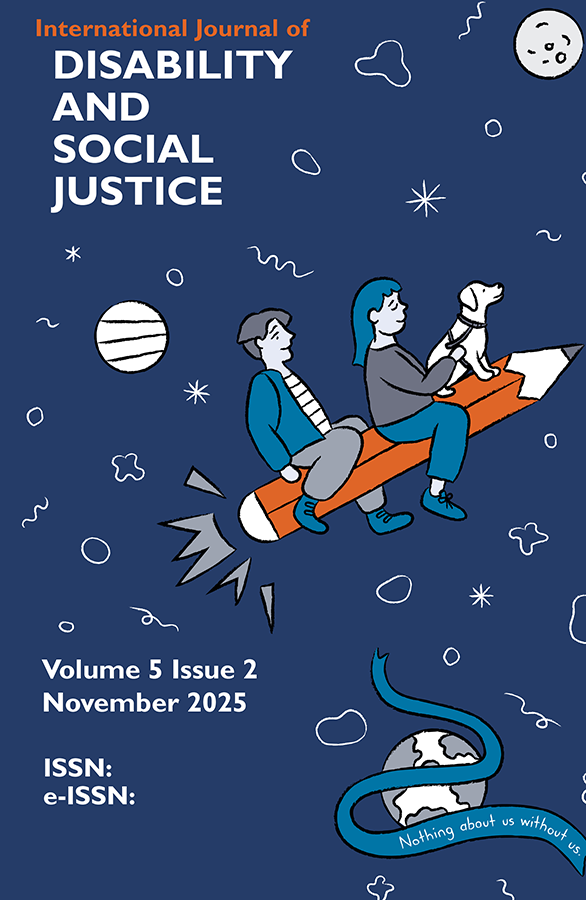
 The latest issue of International Journal of Disability and Social Justice Volume 5, Issue 2, opens with “Introducing “Energy Limiting Conditions”: The Emergence and Evolution of a New Impairment Concept”. In it, Catherine Hale, Dr Anna Ruddock, and Ana Bê describe how the new conceptual language of ‘energy limiting condition’ and ‘energy impairment’ was coproduced with participants of the Chronic Illness Inclusion Project (CIIP) and evolved through the succeeding disabled-led advocacy organisation Chronic Illness Inclusion (CII).
Samriddhi Singh and Aniket Ojha examine how disability experiences and neoliberal policies in India differ substantially from Global North contexts in “Neoliberal Affirmations, Local Distinctions: Disability Policies and Praxes in India”.
In ‘“Not Everybody Enjoys Physical Activity”: A Qualitative Social Media Study of the Barriers Experienced by Autistic Adults’ Andrew M. Colombo-Dougovito, Scott W. T. McNamara, Henny Kupferstein, and A. Josephine Blagrave explore why participation in physical activity among autistic adults remains low compared to their non-autistic peers.
Naomi Lawson explores barriers to accessing church buildings and participating in worship and community life in this qualitative, participatory study with 30 disabled Christians in the UK, ‘“I Just Didn’t Fit into the Way That They Did Church”: Barriers to Access and Participation for Disabled People in UK Churches’ . The issue also features ‘Current Issues Bulletin: Moving Forward from the Current “Disability Anxious Moment” in Disability Studies and Activism: Write up of the CDS PGR Conference 2023’ by Lauren Avery.
Finally, in “Who Owns Our History? Archiving the Disabled People’s Movement”, Ella Clarke, Steve Graby, and Luke Beesley use Manchester’s Disabled People’s Archive as a case study to demonstrate how democratic governance structures and comprehensive accessibility strategies can ensure that archives serve disabled communities rather than simply describe them.
As always, plain English summaries of all the articles are available on the IJDSJ website https://ijdsj.online/current-issue/
The Journal of Fair Trade, Volume 6, Issue 2, is a special issue in collaboration with UNHCR and MADE51. It showcases the MADE51 model and its evolution, including artisan case studies from Uganda and Egypt.
The issue opens with “Fair Trade meets humanitarianism: integrating refugees into a global, creative economy value chain”, in which Heidi Christ, Piedra Lightfoot and Christine Gent show how MADE51 enables social enterprises to work effectively with refugees, helping to integrate displaced people into their local communities and economies. By showcasing products rooted in refugees’ cultural heritage, the initiative highlights how social enterprises can play a vital role in humanitarian efforts.
In “Economic inclusion: qualitative lessons from Egypt”, Jack Hosgood considers how refugees often struggle to access global markets due to legal, social, and economic barriers. Margaret Dear Kasande-Köbel and Stella Hasahya’s article “Supporting refugee artisans in handicraft making through global partnerships” explores how collaboration, skills development, and cultural preservation can enhance refugees’ dignity, economic independence, and integration into the global economy.
In “Refugees’ vulnerability in global supply chains”, Pauline Tiffen and Elaine Jones examine the factors that create vulnerability among refugees, offering a framework to understand forced labour, trafficking, and the impact of company sourcing and advocacy practices.
And finally, after almost 30 years of Fairtrade bananas, the benefits of certification are clear. Alistair Smith and Holly Woodward-Davey consider “Fairtrade’s place in banana history” and identify long-standing issues around worker representation that are yet to be resolved. As the industry moves ever further along the path of living wage implementation, Fairtrade must establish a pathway for its workers’ committees to transition into independent trade unions with the legal status to bargain for wages. The African Journals Initiative’s latest publication is from the Ibadan Journal of Sociology, which is dedicated to advancing knowledge in the field of sociology, with a particular focus on African society and social dynamics.
If you would like to hear about the latest articles from the African Journals Initiative, you can sign up to the newsletter here. You can also follow the African Journals initiative on LinkedIn and BlueSky.