
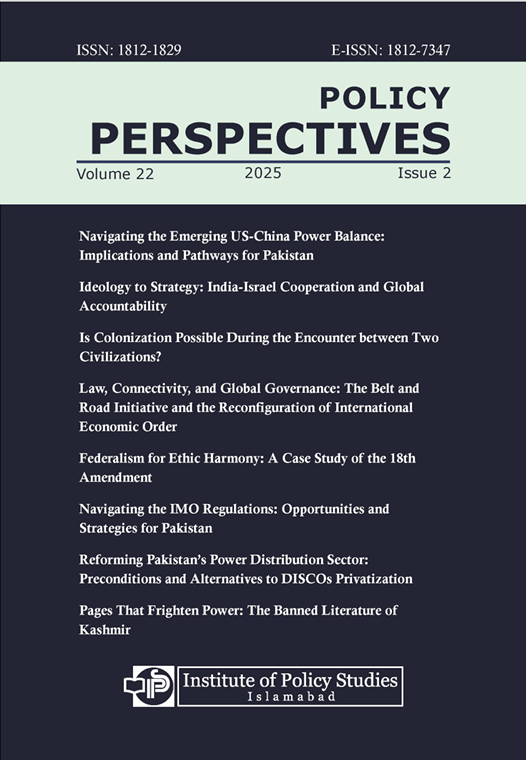
 In the latest issue of Policy Perspectives Volume 22, Issue 2 from the Institute of Policy Studies (IPS) in Islamabad, Sohail Mahmood, Sardar Masood, and Zamir Akram open with “Navigating the Emerging US-China Power Balance: Implications and Pathways for Pakistan”. Faryal Qazi examines the potential of “Reforming Pakistan’s Power Distribution Sector: Preconditions and Alternatives to DISCOs Privatization”.
Muhammad Jawad Akhtar and Muhammad Umair explore “Navigating the IMO Regulations: Opportunities and Strategies for Pakistan”, and Eman Farooq looks at the impact of the 18th Amendment on Ethnic Harmony in “Federalism for Ethnic Harmony: A Case Study of the 18th Amendment”.
In “Is Colonization Possible During the Encounter Between Two Civilizations?” Shahzada Rahim Abbas aims to broaden the historical domain of colonialism by taking the case study of the Islamic and European civilisations’ encounter with other civilisations. Asifa Tanseer examines the expanding strategic relationship between India and Israel while tracing its evolution from a transactional defense partnership to an ideologically infused alliance in “Ideology to Strategy India–Israel Cooperation and Global Accountability”.In “Pages that Frighten Power: The Banned Literature of Kashmir” Waleed Rasool and Malik Waleed examine the 25 books (including Arundhati Roy’s Azadi: Freedom. Fascism. Fiction.) that were proscribed and question how censorship fits with India’s claim to be the World’s largest democracy. Khalid Rahman’s paper “Law, Connectivity, and Global Governance: The Belt and Road Initiative and the Reconfiguration of International Economic Order” looks at the the BRI as an evolving legal and governance paradigm aimed at restoring trust, predictability, equity, and equality among nations, fostering cooperation in cross-border economic relations.
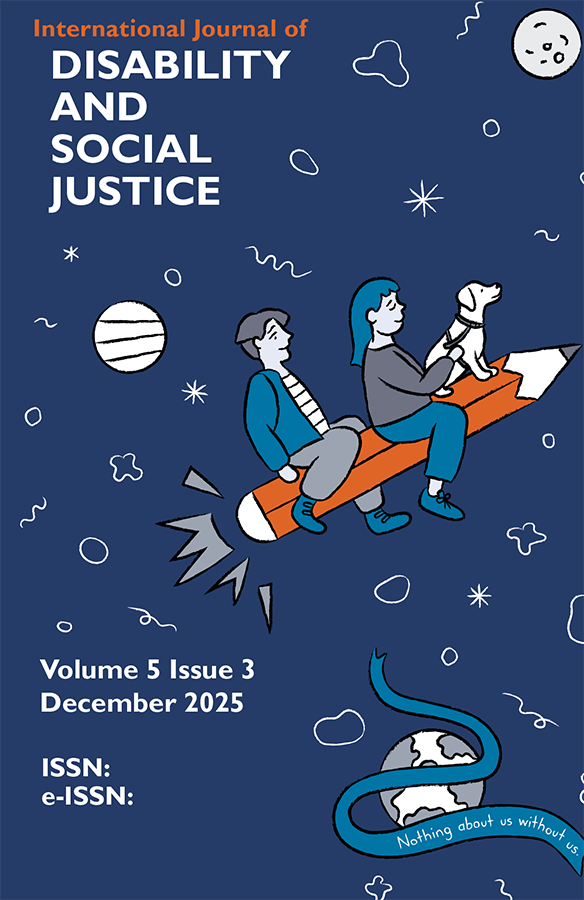 We are pleased to announce that the International Journal of Disability and Social Justice has just been accepted into the Emerging Sources Citation Index, a fantastic achievement for a journal that only launched in 2021!
The latest issue of the Journal of Disability and Social Justice, Volume 5, Issue 3, opens with Martina Smith, Katherine Runswick-Cole, Sara Ryan, Liz Croot, Chris Hatton, Clare Kassa, Rosemary (Rosa) Cisneros, Patty Douglas and The Tea and Cake Group’s “Tired of Spinning Plates: A Rapid Scoping Review of the Mental Health Needs and Mental Health Support of Carers of Adults with Learning Disabilities in the United Kingdom”. Susan Flynn explores “Neurodiversity, Social Work, and Social Justice: Key Issues and Overlaps”.
In “Discursive Discrimination: Ableism and Linguicism in Governmental Documentation – The Case of Swedish Sign Language” Maria (Mia) Larsdotter, Liz Adams Lyngbäck, and Stefan Johansson ask what exactly was decided by the Swedish Parliament in 1981 when they recognised sign language?
In “Mapping the government of disability in myalgic encephalomyelitis/chronic fatigue syndrome: A critical feminist account” Joanne Hunt argues that greater respect for subjugated knowledges could lead not only to a more strongly objective and nuanced understanding of (bio)psychosocial hegemony but also to greater possibilities in terms of resistance.
Afeez Kolawole Shittu and Temitayo Isaac Odeyemi’s paper “From exclusion to inclusion: Assessing disability accessibility and participation in Nigeria’s 2023 general elections” discusses the implications for implementing Article 29 of the United Nations Convention on the Rights of Persons with Disabilities (CRPD) and offers policy recommendations to strengthen electoral governance and advance disability-inclusive democracy in Nigeria and comparable contexts.
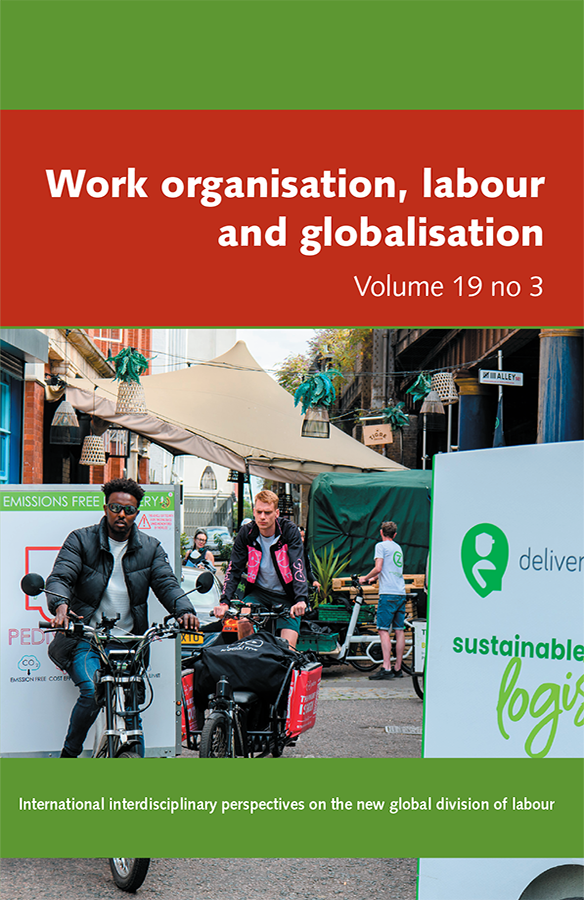 The latest issue of Work Organisation, Labour & Globalisation Volume 19, Issue 3, brings together a rich array of timely and thought-provoking articles. With contributions on women truck drivers in Romania, platform workers in Spain, call centre workers in Mexico, academic interns in Indonesia, ethical entrepreneurs in Czechia and cargo-bike riders in the UK, it offers a unique insight into the similarities and differences in workers’ experiences around the world, as well as the deep contradictions many are confronting today.
Ten articles comprise this latest issue:
“The logistical colonisation of life: Gender, exploitation, and resistance in the work of Romanian women truck drivers” Andreea Pascu
“Cybertariats in the export-oriented service sector: The case of call centres in Mexico” Mateo Crossa
“Practising being precarious workers: State, policy and the labour regime in Indonesian academic
Internships” Anindya Dessi Wulansari
“‘My selfish need to do good’: The solutionist work ethic in Czech emerging ethical enterprises” Tereza Virtová
“‘We’re trying to reimagine this gig economy as a force for good’: Problematising labour processes
in cargo bike logistics” Ersilia Verlinghieri, Charlie Couve, Tiffany Lam and Rachel Aldred
“Spatial differentiation in the gig economy: Factors determining local articulations of a global
Phenomenon” Maria Iancu and Kathleen Hughes
“Riders on the road: An interface-centred analysis of the delivery platform workforce in Spain” Carlos A. Scolari. Mar Guerrero-Pico, Martina Piña and Fernanda Pires
“Do the companies of the future have a future? A case-based overview of the structure,
development and limitations of delivery platforms” Sterenn Lebayle
“Becoming a gig worker: An exploratory life course study of inbound career trajectories in the UK
gig economy” Timothy Charlton, Philipp Hukal and Attila Márton
“Continuity and change: Reflections on over a decade of research on platform-mediated gig work” Niels van Doorn, Niels Beerepoot, Meg Kitamura and Selma Piukovici-Karadag