
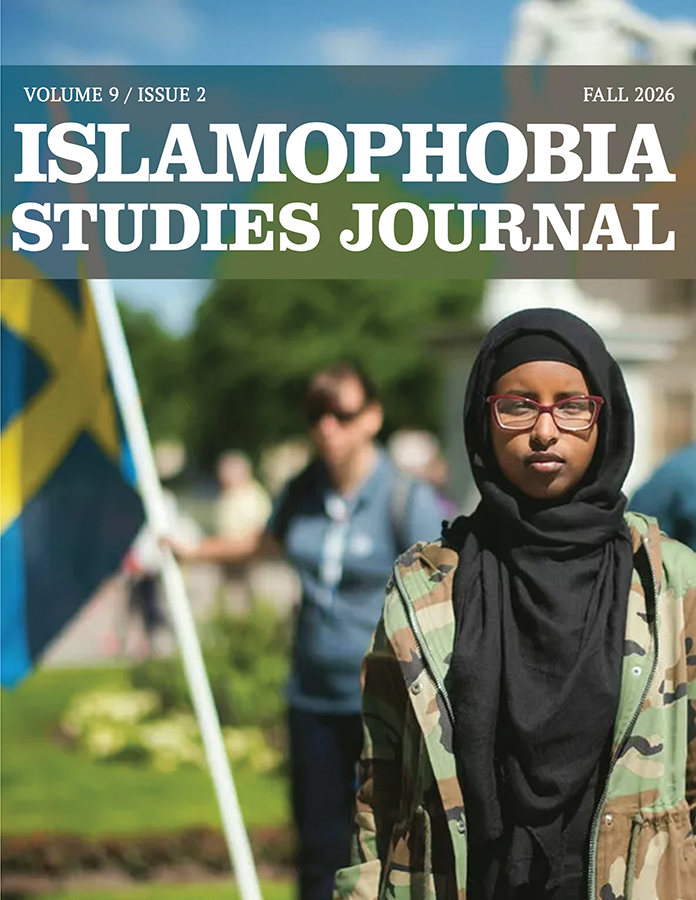
 This special issue of Islamophobia Studies Journal (Volume 9, Issue 2) appears at a decisive moment in Swedish political history, as the country enters an election year in which Islam occupies centre stage in political discourse. In their introduction “Sweden’s Governance of Suspicion: Islamophobia and Conditional Belonging”, Emin Poljarević and Amanj Aziz argue that the patterns are now familiar: Muslims are cast as security threats, portrayed as “non-integrable“ and subjected to demands for cultural conformity presented as prerequisites for democracy.
Ahmad El Far documents how the governance of suspicion reshapes the aims and strategies of Muslim civil society organisations in ‘From “Swedish-Muslimness” to “Muslimness in Sweden”: The Changing Aim of Muslim Civil Society”.
Ahmad El Far draws on interviews with 14 prominent Muslim civil society leaders in Sweden in “Amidst Securitization and Stigmatization: The Everyday Challenges for Swedish-Muslim Civil Society Organizations”.
In “Civic Suspicion and Moral Sorting: Islamophobia, Folkbildning, and the Defunding of Muslim Civil Society in Sweden”, Emin Poljarević diagnoses how the erosion of universal welfare and the rise of neoliberal governance have given way to a racialised “governance of suspicion”, wherein Muslim civic actors are only conditionally included through ideological conformity, cultural transparency, and affective restraint. In “Adjudicating Muslimness: Islamophobia and the Limits of Swedish Law”, Abdi Hassan and Emin Poljarević demonstrate how legal institutions systematically fail to recognise Islamophobia.
In “They Call Us Extremists” Discursive Repression and Shrinking Democratic Space for CSOs in Sweden” Anna Ardin examines qualitative survey responses from 156 Swedish organisations to trace how civil society actors perceive negative labelling as reshaping the boundaries of legitimate participation following recent democracy criteria for public funding. Finally in “Terminology and Exclusion: Muslims, Racism, and Concepts” Amanj Aziz draws on a survey of 39 Muslim organisations, showing that 77 percent use the term “Islamophobia” to describe the racism they face, while Swedish authorities, including in the 2024 National Action Plan against Racism, have unilaterally replaced “Islamophobia” with “anti-Muslim racism”.
 As ReOrient celebrates its 10th Anniversary, Volume 10, Issue 1 opens with Ruth Mas’s editorial “What is the Epistemology of a Genocide? Reflection on ReOrient and Critical Muslim Studies”.
The central focus of this special issue is to explain the dynamic in which Islamophobia is perpetuated in “everyday” life through policies, discourse and social interactions, and to highlight its significance. Izram Chaudry explores this in “Introduction: Making the “Invisible” Visible: Detecting Everyday Islamophobia”. In “Islamophobia as a Racial Microaggression”, Izram Chaudry goes on to offer a theoretical account of why Islamophobic microaggressions occur.
In “The Banality of Islamophobia: Confronting the Hegemonic Ambitions of Counter-Radicalisation” Fahad Ahmad interrogates
how counter-radicalisation initiatives have disproportionately targeted Muslim communities across many Western countries.
In “Enemy of the State: Citizenship, Muslimness and British Values” Claudia Radiven examines how the PREVENT programme, central to the UK’s counter-extremism strategy, significantly contributes to the everyday experiences of Islamophobia faced by Muslims in Britain. In “Conforming to Belong: A Dialogic Exploration of Scottish-Pakistanis’ Experience of Everyday Islamophobic “Policing”’, Abigail L. Cunningham explores how Scottish Pakistani Muslims perceive and experience belonging within the nation. Arthemis Snijders considers workplace microaggressions in “Everyday Gendered Islamophobia in the Workplace: Microaggressions as Expressions of Symbolic Violence Towards Muslim Women in Belgium”. In ‘“White is Right”: Terrorism and the Inclusive Exclusion of Muslim Social Workers’ Sophie Shall draws on the accounts of Muslim social workers to analyse the racial effects of the UK Government’s PREVENT policy.
The issue also includes a series of Exchanges with Schirin Amir-Moazami, introduced by Uzma Jamil in “Exchanges with Schirin Amir-Moazami: Interrogating Muslims”. Bringing together perspectives from different disciplines, the four contributors to Exchanges highlight the points which resonated with them in light of their own (respective) work, while posing questions and reflections that extend the conversation. The contributions are:
● “Interrogating the Liberal-Secular Matrix: The (In)Visible Violence of Muslim assimilation Integration” Anya Topolski.
● “Servants of the State: Integration as a Form of Institutional Policing” Sultan Doughan.
● “Schirin Amir-Moazami on the Epistemic Violence of Integration Politics in the Liberal-Secular Matrix” Jennifer A. Selby.
● “Embodying Secular-Liberalism” Theodore Vial.
● Schirin Amir-Moazami responds in “Integration, Memory, and Reason of State in Times of Genocide”.
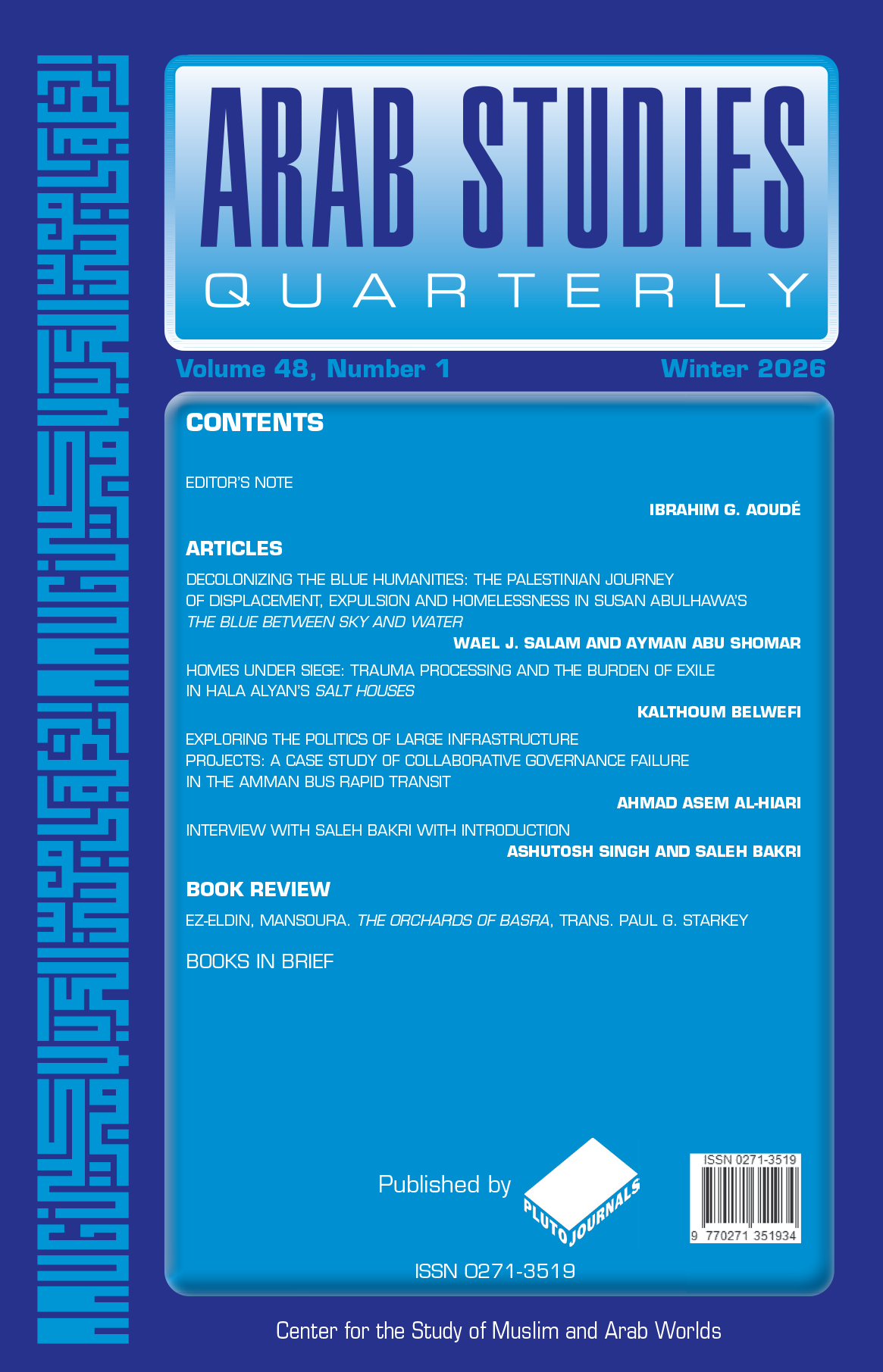 The latest issue of Arab Studies Quarterly (Volume 48, Issue 1) opens with “Decolonizing the Blue Humanities: The Palestinian Journey of Displacement, Expulsion and Homelessness in Susan Abulhawa’s The Blue Between Sky and Water”. In this article, Wael J. Salam and Ayman Abu Shomar reimagine aquatic space as a site of colonial violence and Palestinian resistance. “Homes under Siege: Trauma Processing and the Burden of Exile in Hala Alyan’s Salt Houses” by Kalthoum Belwefi examines the enduring psychological and emotional toll of exile across generations in Palestinian diasporic literature.
In “Exploring the Politics of Large Infrastructure Projects: A Case Study of Collaborative Governance Failure in the Amman Bus Rapid Transit”, Ahmad Asem Al-Hiari positions the case within broader debates on infrastructure development in the Global South, offering critical insights into the political costs of policy failure and the challenges of implementing large-scale projects in complex governance environments.
The latest issue of Arab Studies Quarterly (Volume 48, Issue 1) opens with “Decolonizing the Blue Humanities: The Palestinian Journey of Displacement, Expulsion and Homelessness in Susan Abulhawa’s The Blue Between Sky and Water”. In this article, Wael J. Salam and Ayman Abu Shomar reimagine aquatic space as a site of colonial violence and Palestinian resistance. “Homes under Siege: Trauma Processing and the Burden of Exile in Hala Alyan’s Salt Houses” by Kalthoum Belwefi examines the enduring psychological and emotional toll of exile across generations in Palestinian diasporic literature.
In “Exploring the Politics of Large Infrastructure Projects: A Case Study of Collaborative Governance Failure in the Amman Bus Rapid Transit”, Ahmad Asem Al-Hiari positions the case within broader debates on infrastructure development in the Global South, offering critical insights into the political costs of policy failure and the challenges of implementing large-scale projects in complex governance environments.
Ashutosh Singh explores the role of Palestinian cinema as a vital site of cultural expression and resistance in “Interview with Saleh Bakri with Introduction”. The introduction and interview position Palestinian cinema as both a mirror of collective struggle and a powerful medium for asserting agency, memory, and the ongoing pursuit of liberation.