
 The African Journals Initiative is looking for six more African based journals to partner with in 2027. Applications are open here until the deadline of 30th September 2026. Please share with colleagues.
We are pleased to share the latest publications from the African Journals Initiative: Ghana Journal of Sociology & Anthropology (Volume 9, Issue 2) and People Centred – The Journal of Development Administration (Volume 11, Issue 1).
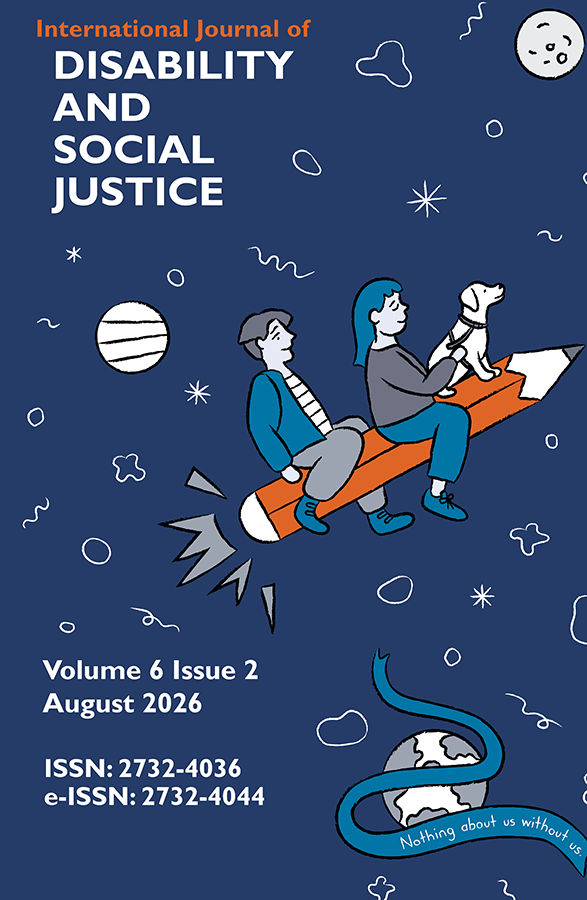 International Journal of Disability and Social Justice (Volume 6, Issue 2) presents an impressive selection of international articles addressing the impact of climate change, technology and war. The issue opens with the authors’, Queensley C. Chukwudum and David O. Anyaele, examination of “Intersectionality of Disability and Climate Change Threats: Identifying the Unique Vulnerabilities Faced by Persons with Disabilities in Abia State Nigeria Using the Subgroup Chart Technique”.
Stina Melander explores participation in the disability movement from the perspective of individuals with acquired impairments, with empirical focus on Sweden’s high civil society engagement in “This Is Not What I Thought Life Would Be Like”: Participation in the Disability Movement after a Trauma”.
In “The Paradox of Progress and Accessibility: Ableism and Neoliberalism in Iceland’s Digital Transformation Policies” Inga Björk Margrétar Bjarnadóttir, Ingólfur Ásgeir Jóhannesson, and Laufey Elísabet Löve highlight significant challenges in incorporating a commitment to human rights within digital transformation, which frequently falls short of addressing the rights and needs of disabled people. Many conventions for representing disabled people in film have not changed since the dawn of cinema. In “Development of the People or Props Tool: Integrating Prejudice Reduction Psychology Insights to Improve Representations of Disability on Screen” Richard Amm develops a research-based tool to help dismantle and replace these problematic conventions. Gauthier de Beco and Marketa Bacakova consider “The Deinstitutionalisation of Children with Disabilities in Times of Armed Conflict: The Russian Full-Scale Invasion of Ukraine”. Finally, in “Disability as a Determinant of Diabetes Self-Management: A Comparative Case Study from Rural South India” Rajeswaran Thiagesan and Vijayaprasad Gopichandran, clinicians working in a rural community-based voluntary health organisation, discuss this case study using the intersectionality lens. The latest issue of Prometheus – Critical Studies in Innovation (Volume 40, Issue 2&3) begins with another entertaining editorial from Stuart Macdonald exploring why companies are buying up journals and how they make money from “zombie” journals “Journal for sale? What offers?”.
In “Higher education research on the dark side of digitalisation: the subtle reproduction of technological solutionism” Gerrit Kiewiet and Jelle Mampaey consider how COVID-19 forced higher education institutions into an overnight shift to remote teaching and how Big Tech companies have been empowered to track student behaviour through surveillance practices, invasive profiling, and unauthorised surveillance, positioning users as consumers of technology rather than as academic learners. Scientific breakthroughs tend not to begin life as polished theories.
Tan Aik Kah sees “Preprints as anticipatory infrastructures: preserving the generative phase of trans-disciplinary innovation” expanding society’s capacity to imagine, contest, and co-create knowledge futures. In “Playing catch-up: Can the use of innovative externally orientated management accounting techniques create and sustain competitive advantage?” Babajide Oyewo, Kolawole Adeyemi Alo, Adeyemo Kingsley Aderemi, Palto Datta and Oluwamayowa Olalekan Iredele are interested in how innovative approaches to accountancy can shed new light on what they measure in the manufacturing industry in Nigeria. In “Exploration of the origins and development of disruptive innovation theory” Jianming Zhou, Qi Feng, Minghan Su and Bin Xie look at publications in the field to work out what is going on and to classify the results. English language papers are compared with those in Chinese. Loitongbam Athouba Meetei and Dilip S. Mutum explore “The paradox of global excellence and local relevance: universities’ third mission in developing economies”. The paper highlights the crucial role of intermediaries and academic volunteers in technology transfer from universities. It also identifies specific barriers experienced with technology transfer to rural areas, such as cultural resistance, lack of sustained support, and institutional constraints. In “Latent optics: the capture of peripheral surveillance through Public Space CCTV” Janos Mark Szakolczai considers that the camera captures not only intended information, but also information from the periphery that can be combined with data from other cameras for analysis and discovery of what was not even sought. Finally, Victor P. Seidel looks at what the classics have to say about innovation in “Comparing logics of organizing across Plato, Aristotle and Machiavelli: tensions and implications for innovation management and responsible innovation”.