 Whether you are enjoying the summer or trying to keep cool, we have a wonderful range of thought provoking articles from the Journal of Fair Trade, World Review of Political Economy and the mega final issue of Work Organisation, Labour & Globalisation. We want to thank Ursula Huws for all her work on this important and prescient journal which has documented, examined and challenged the impact of technology on labour, while bringing greater visibility to the people behind the often invisible work that shapes our everyday lives.
Discover our full collection on ScienceOpen.
Whether you are enjoying the summer or trying to keep cool, we have a wonderful range of thought provoking articles from the Journal of Fair Trade, World Review of Political Economy and the mega final issue of Work Organisation, Labour & Globalisation. We want to thank Ursula Huws for all her work on this important and prescient journal which has documented, examined and challenged the impact of technology on labour, while bringing greater visibility to the people behind the often invisible work that shapes our everyday lives.
Discover our full collection on ScienceOpen. 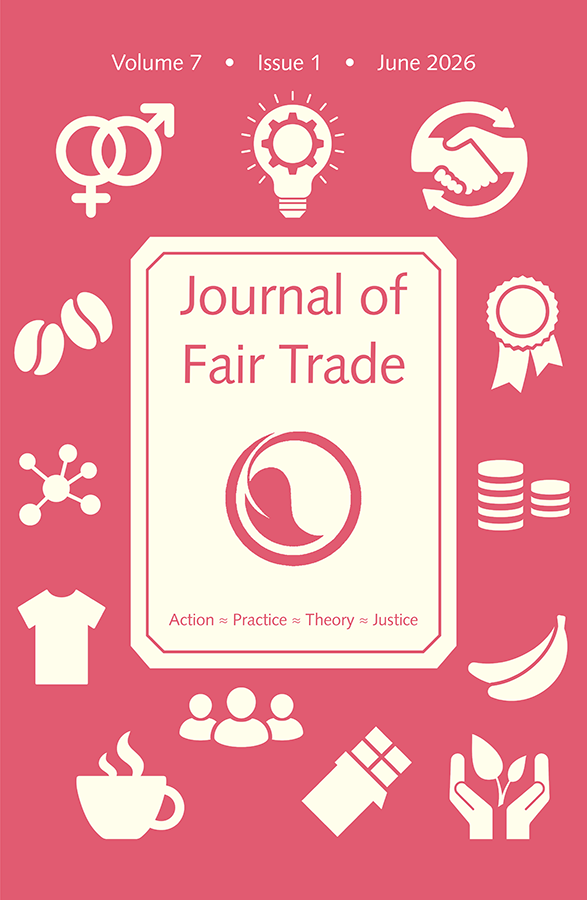 The latest issue of the Journal of Fair Trade (Volume 7, Issue 1) opens with a commentary on the wider importance of Diamond Open Access for inclusion, bibliodiversity, and global accessibility from editor in chief, Pauline Tiffen,“Diamond open access: The epitome of a challenge to oligopolistic and predatory knowledge creation systems: The case of the Journal of Fair Trade’.
In “Bringing justice to fair trade in agri-food value chains’ Ruerd Ruben outlines the implications of applying a justice lens to Fair Trade operations, based on a detailed analysis of the institutional factors that determine the farmer’s share in the end price of the value chains of coffee, cocoa and bananas. Sadie Walton examines “The Coffee Value Chain: From Fairtrade to Direct Trade”. Drawing on Karl Polanyi’s concept of the double movement, the analysis situates both approaches as responses to disruptions caused by the liberalisation of the global coffee market following the collapse of the International Coffee Agreement.
In “I Beg Your Pardon. Did You Just Say Free Trade Can Be Fair Trade?”, Brauer, Dergic and King contend that unrestricted markets do not automatically produce beneficial results and that justice, rights and sustainability require both freedom to participate in markets and freedom from poverty, injustice and environmental harm. Pratiti Roy explores “Memory of Migrants: Life and challenges of migrant workers in India during and after Covid-19”. Drawing qualitative analysis of scholarly literature and media accounts, Roy exposes deep social inequalities and systemic failures faced by these people and highlights the economic hardship, social exclusion and rights violations experienced during mass internal displacement. (See Volume 6, Issue 2 for further articles on refugees, IDPs and vulnerable workers by MADE 51, UNHCR, IOM and others).
The latest issue of the Journal of Fair Trade (Volume 7, Issue 1) opens with a commentary on the wider importance of Diamond Open Access for inclusion, bibliodiversity, and global accessibility from editor in chief, Pauline Tiffen,“Diamond open access: The epitome of a challenge to oligopolistic and predatory knowledge creation systems: The case of the Journal of Fair Trade’.
In “Bringing justice to fair trade in agri-food value chains’ Ruerd Ruben outlines the implications of applying a justice lens to Fair Trade operations, based on a detailed analysis of the institutional factors that determine the farmer’s share in the end price of the value chains of coffee, cocoa and bananas. Sadie Walton examines “The Coffee Value Chain: From Fairtrade to Direct Trade”. Drawing on Karl Polanyi’s concept of the double movement, the analysis situates both approaches as responses to disruptions caused by the liberalisation of the global coffee market following the collapse of the International Coffee Agreement.
In “I Beg Your Pardon. Did You Just Say Free Trade Can Be Fair Trade?”, Brauer, Dergic and King contend that unrestricted markets do not automatically produce beneficial results and that justice, rights and sustainability require both freedom to participate in markets and freedom from poverty, injustice and environmental harm. Pratiti Roy explores “Memory of Migrants: Life and challenges of migrant workers in India during and after Covid-19”. Drawing qualitative analysis of scholarly literature and media accounts, Roy exposes deep social inequalities and systemic failures faced by these people and highlights the economic hardship, social exclusion and rights violations experienced during mass internal displacement. (See Volume 6, Issue 2 for further articles on refugees, IDPs and vulnerable workers by MADE 51, UNHCR, IOM and others). 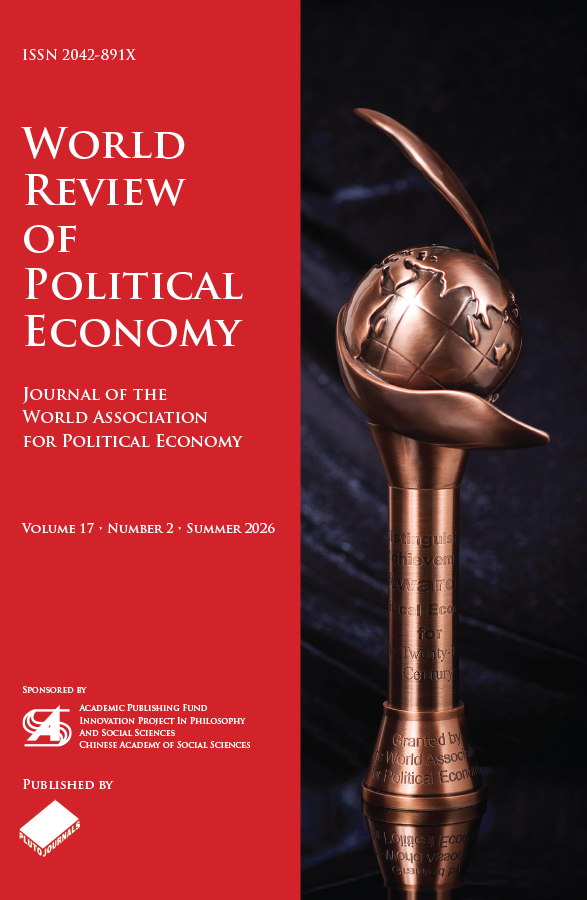
The latest issue of World Review of Political Economy (Volume 17, Issue 2) begins with Thomas E. Lambert’s article “Long Wave Economic Cycles, Political Realignment Elections, and the Baran Ratio”, which explores the macroeconomic concept of economic surplus, defined as income exceeding what is necessary for society’s essential needs such as housing, education, food, and clothing. The article suggests that the U.S. and global economies may be approaching a transition point in a long wave cycle, potentially leading to major political shifts and realignment elections in the near future.
In “Peripheral Economies and the Dollar Hegemony: Quest for the Alternatives”, Sudipta Jha examines how U.S. dollar dominance shapes the development prospects of peripheral economies and proposes a supranational international currency based on macroeconomic fundamentals and purchasing power parity to reduce imbalances, speculation, and dependency.In “Unequal Exchange in Debate: Placing Superexploitation at the Centre of the Analysis” Mateo Crossa and Cristóbal Reyes explain how workers in dependent economies are systematically paid below the value of their labor, concentrating capital in export sectors while weakening domestic industries. The authors conclude that technological change reinforces structural dependency and inequality by sustaining superexploitation in peripheral capitalist economies.
Bayo Ayodeji examines the 2024 UK farmers’ protests in “Farmers’ Protests and the Organic Crisis of British Capitalism”, and argues that the protests emerged in response to government attempts to manage the long-standing structural crisis facing British capitalism. The study concludes that temporary economic recovery does not change capitalism’s overall long-term decline and loss of progressive potential. Chenxi Gao’s article “Beyond Dichotomy: Rethinking the Productive and Unproductive Labour Distinction in Classifying Modern Service” critiques the use of the Marxist distinction between productive and unproductive labour (PUPL) in analysing modern service industries and concludes that service industries require sector-specific approaches instead of generalised classifications. Finally, a review of the first workshop on heterodox macroeconomic models held in Greece 2025 is given by Stavros Mavroudeas and Costas Passas.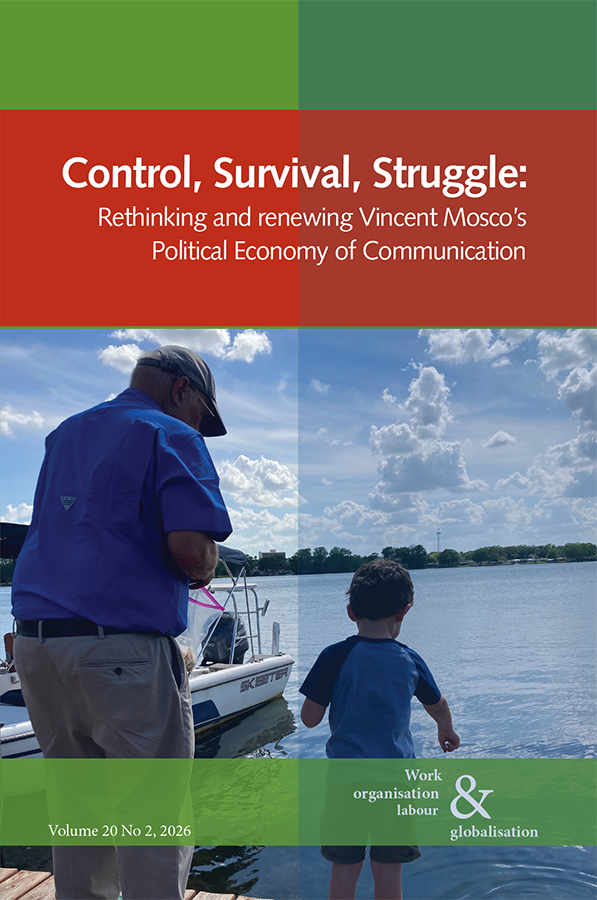
After 20 illustrious years, Ursula Huws, the inimitable Editor in Chief presents the final issue of Work Organisation, Labour & Globalisation (Volume 20, Issue 2). The issue pays tribute to the intellectual legacy of Vincent Mosco, a towering figure in the political economy of communication who supported the journal from its inception. Mosco was prescient in writing about many important contemporary issues such as the importance of the cloud and its environmental implications, AI and the concept of ‘smart cities’, long before they reached the attention of most politicians or academics. He anticipated many of the questions that now confront us so urgently.
Rather than simply memorialising his scholarship and praxis, this special issue looks to the future. Leading figures in the political economy of communications apply Mosco’s theoretical approach to pressing issues that confront us today, presenting cutting-edge research on the impact of AI on labour, education and daily life, the relationship of the Trump administration to media and Big Tech corporations, and the new political and institutional configurations that are emerging in the military-industrial complex.
Articles highlight the continuing relevance of Mosco’s contributions to political-economic scholarship, pedagogies, research methods and labour studies. At the end of his career, Mosco wrote eloquently about the importance of developing alternative utopias as a means of imagining democratic futures and inspiring hope. The issue ends with a group of articles that address this final, crucial goal.
Edited by Catherine McKercher, Leslie Regan Shade, Nicole Cohen and Ursula Huws, this issue includes contributions from: