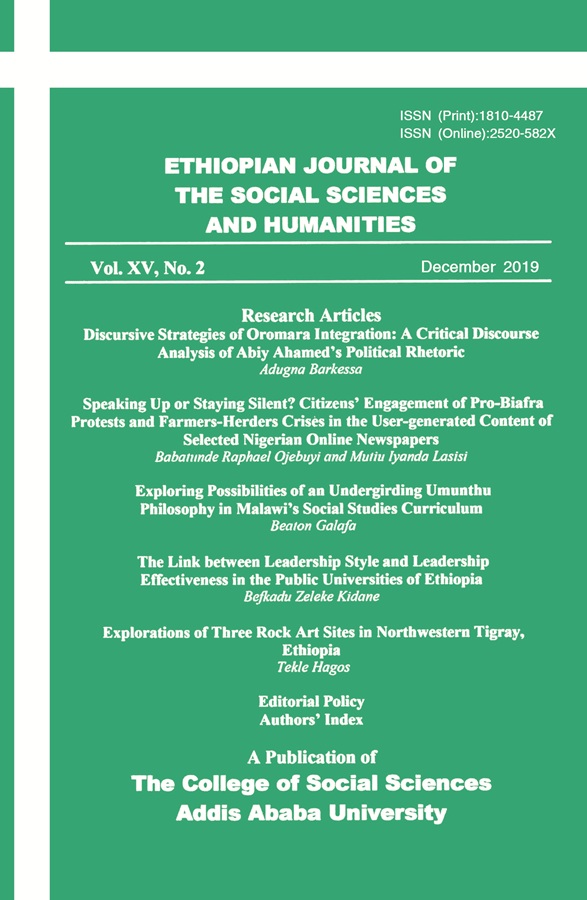
Ethiopian Journal of the Social Sciences and Humanities
Ethiopian Journal of the Social Sciences and Humanities (EJOSSAH) is a double-blind scholarly publication of the College of Social Sciences, Arts and Humanities of Addis Ababa University. It is a biannual multidisciplinary academic periodical that publishes research articles, book reviews and short communications of regional and global relevance. EJOSSAH encourages interested scholars, students and professionals to submit their original manuscripts for publication.
Print ISSN: 1810-4487
Online ISSN: 2520-582X


The Ethiopian Journal of the Social Sciences and Humanities (EJOSSAH) is a biannual, double-blind peer-reviewed diamond open-access journal dedicated to promoting fresh scholarly enquiry on Ethiopia and the Horn of Africa. It was officially launched in 2003 as the official journal of the College of Social Sciences, Addis Ababa University.
EJOSSAH publishes original papers that have not been published previously. These include articles based on original research using primary empirical data, including surveys, in-depth interviews, key informant interviews, focus group discussions (FGD), archives, newspapers, and government and non-governmental organisation documents, or articles developed using secondary data. In the latter case, the author should clearly outline their fresh or new contribution or a new reinterpretation of the existing literature. In addition, EJOSSAH publishes book reviews, short communications, obituaries, and conference papers.
Contributions to the journal shall be submitted in English.
EJOSSAH is dedicated to promoting fresh scholarly enquiry on Ethiopia and the Horn of Africa. It is devoted to empirical and analytical research and its application in social sciences and humanities. The journal publishes original research articles, literature reviews, book reviews, short communications, obituaries, and conference papers.
Editor-in-Chief
Dr. Asnake Kefale (Associate Professor), Department of Political Science and International Relations, Addis Ababa University, Ethiopia.
Email: asnake.kefale@aau.edu.et
Deputy Editor-in-Chief
Dr. Ashenafi Hagos Baynesagn (Associate Professor), School of Social Work, Addis Ababa University, Ethiopia.
Email: ejossah.d.chiefeditor@aau.edu.et
Managing Editor
Aman Mohammedsaid, Addis Ababa University, Ethiopia.
Email: ejossahme@aau.edu.et
Associate Editors
Dr. Dechasa Abebe Demisie, African Studies, Addis Ababa University, Ethiopia.
Professor Getnet Tadele, Department of Sociology, Addis Ababa University, Ethiopia.
Dr. Guday Emirie Kassahun, Department of Social Anthropology, Addis Ababa University, Ethiopia.
Dr. Tebarek Lika Megento, Department of Geography and Environmental Studies, Addis Ababa University, Ethiopia.
Dr. Yonas Ashine Demisse, Department of Political Science and International Relations, Addis Ababa University, Ethiopia.
Dr. Wassie Kebede Reda, School of Social Work, Addis Ababa University, Ethiopia.
Dr. Samuel Tefera, African Studies, Addis Ababa University, Ethiopia.
International Advisory Board
Professor Bekele Gutema, Addis Ababa University, Ethiopia.
Dr. Emebet Mulugeta, Addis Ababa University, Ethiopia.
Professor George Klute, Bayreuth University, Germany
Professor Jon Abbink, Leiden University, The Netherlands
Professor Masayoshi Shigeta, Kyoto University, Japan
Professor Masresha Fetene, Addis Ababa University, Ethiopia.
Professor M. B. Ramose, Limpopo University, South Africa
Professor Nethan Linsk, University of Illinois, USA
Professor Steven Brandt, University of Florida, USA
Professor Shiferaw Bekele, Addis Ababa University, Ethiopia.
Professor Tegegne G/Egziabher, Addis Ababa University, Ethiopia.
Professor Tesema Ta’a, Addis Ababa University, Ethiopia.
Privacy Statement
The names and email addresses entered in this journal site will be used exclusively for the stated purposes of the journal and will not be made available for any other purpose or to any other party.
Please see the submission guidelines here.
The Ethiopian Journal of the Social Sciences and Humanities (EJOSSAH) is published biannually in June and December. The journal’s backlog is archived on AJOL. EJOSSAH is indexed in EJOL, AJOL, and DOAJ.
As of joining the African Journals Initiative, the journal is published as Diamond Open Access on ScienceOpen. The Open Access statement, license terms, copyright terms, Reuse rights of published material and a statement on its absolute lack of author charges can be found here. The Ethiopian Journal of the Social Sciences and Humanities (EJOSSAH) maintains a fully charge-free policy to all manuscript submissions and processing. There are no submission, review, or publication fees.
Authors may also enter into separate arrangements for non-exclusive distribution of their published paper (e.g., posting to an institutional repository or publishing in a book), with acknowledgement of its initial publication in EJOSSAH.
Article Processing Charges (APC): Free — there are no submission, review, or publication fees.
This journal follows Pluto Journals’ Ethics and Code of Conduct policy https://www.plutojournals.com/codeofconduct/, which aligns with the ethical standards endorsed by the Committee on Publication Ethics (COPE) at https://publicationethics.org/. In particular:
- We expect all authors to state in their article if they have a conflict of interest which could potentially bias their opinions—for example, funding or employment relationships. Authors must disclose any conflict of interest related to the manuscript on a separate page after the references.
- All named authors on articles should confirm that they have jointly participated in the research and writing of the article, and that no author has been omitted from the list of authors.
- We require authors to warrant that their articles are original, have not been previously published, and do not plagiarise or otherwise copy someone else’s work without attribution. Authors must confirm that submissions are not under review elsewhere.
- We also require authors to warrant that their article does not defame, libel, or bring another person into disrepute, and neither does it contain anything illegal (e.g., copyright infringement).
- Editors and reviewers must disclose any potential conflicts of interest that could influence, or be perceived to influence, their handling of a manuscript. Conflicts may include personal relationships, academic competition, or financial interests related to the work under consideration. If a conflict exists, editors and reviewers must decline to participate in the review or editorial decision-making process. The journal maintains procedures to ensure that editorial decisions are made without bias and based solely on scholarly merit. Editors are not involved in decisions about papers in which they have a conflict of interest and such submissions are handled by another qualified editor.
- Where research involves human subjects, authors must confirm in the manuscript that informed consent was obtained and that the study was conducted in accordance with applicable laws and institutional rules and that appropriate IRB approval was obtained. Human participants’ private rights must be respected at all times.
- All submissions are checked for originality during the editorial review. The reviewer’s role includes the process of checking and dealing with text similarity and suspected plagiarism. Plagiarism includes the unattributed use of another author’s words, ideas, data, or images, as well as excessive text recycling from one’s own prior work. Authors wishing to reproduce figures, tables, or other materials previously published elsewhere must obtain written permission from the copyright holder(s). Reviewers are responsible for reporting potential misconduct concerns to the Editor, who handles concerns according to the COPE plagiarism flowchart https://members.publicationethics.org/sites/default/files/plagiarism-submitted-manuscript-cope-flowchart.pdf. Manuscripts found to contain significant plagiarism are rejected, and if plagiarism is discovered after publication, the journal may issue a correction or retraction and notify the authors’ institution as appropriate. The editor is responsible for guiding the process and for publishing corrections, retractions, or expressions of concern when appropriate. All authors will be informed and their consent (where possible) obtained before any changes are made. Appropriate measures will be taken, including possible retractions of articles, when cases of scholarly misconduct are detected.
- Retraction of articles may be required when there is clear evidence that the findings are unreliable due to misconduct (e.g., data fabrication, plagiarism) or honest error; when the work has been previously published elsewhere without proper attribution; or when the research or publication process was unethical. Retraction notices are published promptly, clearly identified as such and linked to the original article, which remains in the public record but marked as retracted. The notice will include the reasons for retraction and who is retracting the article.
- Corrections (errata or corrigenda) are published by the journal to ensure the accuracy and integrity of the scholarly record. If an error is identified that affects the publication’s reliability, but not its overall conclusions, a correction will be issued. Corrections will clearly describe the change, reference the original article, and be freely accessible. Minor errors that do not affect the interpretation of the work will not typically warrant formal correction.
- Appeals: should an author wish to appeal a decision of Reject, they should write to the Editorial Executive. Two members of the Editorial Board not involved in the original review process for the article will reconsider the article and reviews and submit their recommendations. Only one round of appeal will be permitted per manuscript.
Contact:
Ethiopian Journal of the Social Sciences and Humanities (EJOSSAH)
College of Social Sciences
P.O. Box 1176
Addis Ababa University
Addis Ababa, Ethiopia
Deputy Editor-in-Chief: ejossah.d.chiefeditor@aau.edu.et
Publisher: Pluto Journals, evek@plutojournals.com