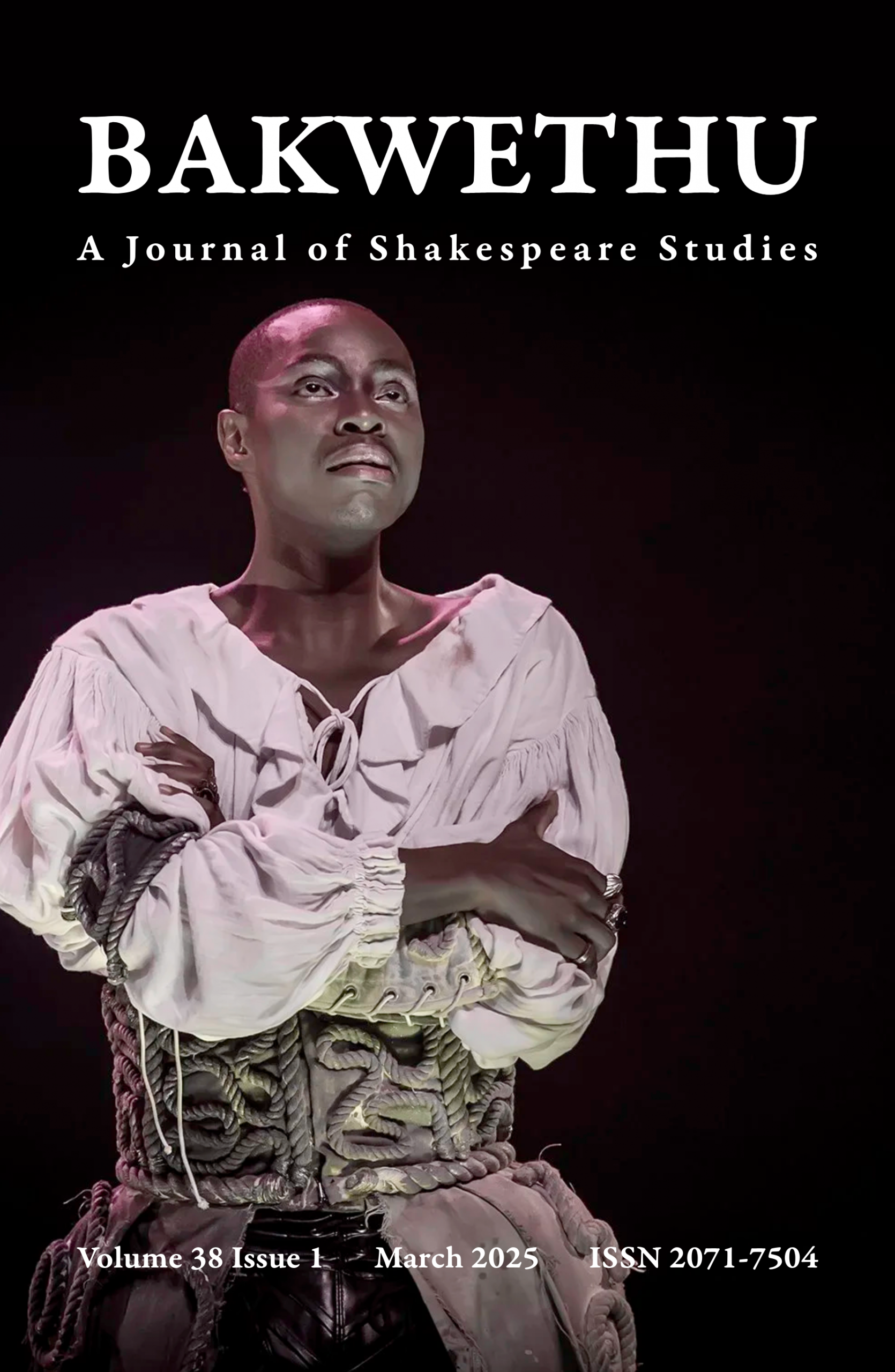
Bakwethu
Bakwethu is an international, biannual, peer-reviewed open-access journal exploring Shakespeare from global perspectives, particularly African and Global South contexts. The journal disrupts traditional Anglocentric approaches by foregrounding underrepresented voices and methodologies. Its isiZulu title, meaning “compatriots” and “my people,” reflects commitment to local perspectives and global dialogue. Bakwethu publishes research articles, essays, reviews, and interviews examining Shakespeare through postcolonial theory, performance practice, translation, pedagogy, and critical race studies.
Print ISSN: 1011-582X,
Online ISSN: 2071-7504
Bakwethu is an international, biannual, peer-reviewed open-access journal dedicated to exploring Shakespeare from global perspectives, with particular emphasis on voices from Africa and the Global South. Published in June and December, the journal seeks to disrupt traditional Anglocentric approaches to Shakespeare scholarship by foregrounding methodologies, artistic engagements, and critical perspectives that have historically been underrepresented in the field.
The journal’s title derives from K.E. Masinga’s 1950s isiZulu radio adaptation of Julius Caesar, where “friends, Romans, countrymen” became “Zihlobo, Bakwethu, MaRomani.” “Bakwethu,” meaning both “compatriots” and “my people,” reflects the journal’s dual commitment to speaking from local perspectives while fostering inclusive global dialogue.
Bakwethu publishes rigorous, creative research including articles, essays, commentary, roundtables, interviews, and reviews of books, theatre, and film. The journal particularly welcomes contributions that challenge centre-margin dynamics, explore postcolonial and decolonial frameworks, examine translation and adaptation practices, investigate pedagogical approaches, and address questions of race, identity, and cultural exchange.
Formerly Shakespeare in Southern Africa, Bakwethu is published by Pluto Journals in partnership with the Shakespeare Society of Southern Africa. The journal maintains a completely charge-free policy and publishes all content under a CC BY 4.0 open-access license on ScienceOpen.
Bakwethu creates a space for rigorous, creative research that reflects the plurality of Shakespearean engagements worldwide. The journal’s mission is to transcend geographic and national boundaries, building community and conviviality among scholars, practitioners, and readers who engage with Shakespeare from non-traditional perspectives. The journal carries research articles, essays, commentary, roundtables, interviews, and book, theatre, and film reviews. We particularly welcome contributions that challenge centre-margin dynamics in Shakespeare scholarship, explore Shakespeare in African and Global South contexts, examine translation, adaptation, and performance practices, engage with postcolonial and decolonial theoretical frameworks, investigate pedagogical approaches to Shakespeare, and address questions of race, identity, and cultural exchange. The term “Bakwethu” signals both heritage and horizons, honouring South African Shakespeare traditions while opening new scholarly possibilities for global dialogue.
Editor-in-Chief
Dr. Marguerite de Waal, University of the Witwatersrand, South Africa
Editorial Board Members
Ifeoluwa Aboluwade – University of Bayreuth, Germany
Amrita Dhar – Ohio State University, United States
Michael Dobson – University of Birmingham, United Kingdom
Ruben Espinosa – Arizona State University, United States
Colette Gordon – University of the Witwatersrand, South Africa
Peter Holland – University of Notre Dame, United States
Raphaël Ingelbien – Katholieke Universiteit Leuven, Belgium
Alexa Alice Joubin – George Washington University, United States
Peter W. Marx – University of Cologne, Germany
Hassana Moosa – University of Cape Town, South Africa
Amrita Sen – University of Calcutta, India
David Schalkwyk – Queen Mary University of London, United Kingdom
Charlotte Scott – The Shakespeare Birthplace Trust / Goldsmiths College, United Kingdom
Katherine Scheil – University of Minnesota, United States
Kathryn Vomero Santos – Trinity University, United States
Robert Stagg – Texas A&M University, United States
Jyotsna Singh – University of Michigan, United States
Serena Talento – University of Bayreuth, Germany
Ayanna Thompson – Arizona State University, United States
Christina Wald – University of Konstanz, Germany
Sandra Young – University of Cape Town, South Africa
Please see the submission guidelines here.
Editor-in-Chief: Dr. Marguerite de Waal
University of the Witwatersrand, South Africa
Email: marguerite.dewaal@wits.ac.za
Society Information: Shakespeare Society of Southern Africa
Johannesburg, South Africa
Website: https://shakespeare.org.za
Society Website: https://shakespeare.org.za/bakwethu
The Journal is published biannually in June and December. Formerly Shakespeare in Southern Africa, the journal backlog is archived in Sabinet and on AJOL.
As of 1 January 2026, the journal is Open Access and the Open Access statement, Open Access license terms, copyright terms as well as a statement on its absolute lack of author charges can be found here. Bakwethu maintains a fully charge-free policy to all manuscript submissions and processing.
The journal is published Open Access on ScienceOpen. This means the Reuse rights of published material is all under the open CC BY 4.0 license as stated here.
This journal follows Pluto Journals’ Ethics and Code of Conduct policy, which aligns with the ethical standards endorsed by the Committee on Publication Ethics (COPE). In particular:
- We expect all authors to state in their article if they have a conflict of interest which could potentially bias their opinions – for example funding or employment.
- All named authors on the articles should confirm that they have jointly participated in the research and writing of the article, and that no author has been omitted from the list of authors.
- We require authors to warrant that their articles are original, have not been previously published, and do not plagiarise or otherwise copy someone else’s work without attribution. (If the article is a translation, we are happy to consider this for publication but the authors must inform the editors on submission).
- We also require authors to warrant that their article does not defame, libel, or bring another person into disrepute, and neither does it contain anything illegal (e.g. copyright infringing).
- Editors and reviewers must disclose any potential conflicts of interest that could influence, or be perceived to influence, their handling of a manuscript. Conflicts may include personal relationships, academic competition or financial interests related to the work under consideration. If a conflict exists, editors and reviewers must decline to participate in the review or editorial decision-making process. The journal maintains procedures to ensure that editorial decisions are made without bias and based solely on scholarly merit. Editors are not involved in decisions about papers in which they have a conflict of interest and such submissions are handled by another qualified editor.
- All submissions are checked for originality during the editorial review. The reviewer’s role includes the process of checking and dealing with text similarity and suspected plagiarism. Plagiarism includes the unattributed use of another author’s words, ideas, data, or images, as well as excessive text recycling from one’s own prior work. Reviewers are responsible for reporting potential misconduct concerns to the Editor, who handles concerns according to the COPE plagiarism flowchart https://members.publicationethics.org/sites/default/files/plagiarism-submitted-manuscript-cope-flowchart.pdf. Manuscripts found to contain significant plagiarism are rejected, and if plagiarism is discovered after publication, the journal may issue a correction or retraction and notify the authors’ institution as appropriate. The editor is responsible for guiding the process and for publishing corrections, retractions or expressions of concern when appropriate. All authors will be informed and their consent (where possible) obtained before any changes are made. Appropriate measures will be taken, including possible retractions of articles, when cases of scholarly misconduct are detected.
- Retraction of articles may be required when there is clear evidence that the findings are unreliable due to misconduct (e.g., data fabrication, plagiarism) or honest error; when the work has been previously published elsewhere without proper attribution; or when the research or publication process was unethical. Retraction notices are published promptly, clearly identified as such and linked to the original article, which remains in the public record but marked as retracted. The notice will include the reasons for retraction and who is retracting the article.
- Corrections (errata or corrigenda) are published by the journal to ensure the accuracy and integrity of the scholarly record. If an error is identified that affects the publication’s reliability, but not its overall conclusions, a correction will be issued. Corrections will clearly describe the change, reference the original article, and be freely accessible. Minor errors that do not affect the interpretation of the work will not typically warrant formal correction.
- Appeals: should an author wish to appeal a decision of Reject, they should write to the Editorial Executive. Two members of the Editorial Board not involved in the original review process for the article will reconsider the article and reviews and to submit their recommendations. Only one round of appeal will be permitted per manuscript.