
 The African Journals Initiative is looking for six more African based journals to partner with in 2027. Applications are open here. The deadline for applications is 30th September 2027, although we welcome earlier applications and requests for informal discussions prior to making an application.Visit the African Journals Initiative page to see the current collection here. If you would like to hear about the latest articles from the initiative, you can sign up to the newsletter here.
 This thought-provoking issue of Journal of Global Faultlines (Volume 13, Issue 1) begins with Bulent Gökay and Lily Hamourtziadou’s editorial “The war on Iran, the petrodollar, and US hegemony”, which considers whether US intervention in Iran marks the end of the ‘American Century’ and the beginning of a prolonged decline in US hegemony.
The issue continues to explore these existential themes through Timothy Mellish’s article “Neo-imperial coercion or strategic miscalculation? Trump’s interventions in Venezuela and Iran and the geopolitical ascendancy of China”. The article examines the military intervention in Venezuela in January 2026 and the war against Iran as interconnected expressions of a coherent, foreign policy doctrine aimed at containing Chinese power.
In “To what extent did Syria’s domestic legal framework on torture under the Assad regime comply with its obligations under international law, and how did the structure of its legal and political system contribute to widespread systemic torture and impunity?” Yousra Jenkal analyses human rights violations in Syria under the Assad regime. David Lewis, Katie Oxley, and Jonathan Jackson contend that those who engage in corrupt practices become an essential and destructive weapon in the enemy’s arsenal in “The weaponization of corruption: Critical examination of challenging corrupt judicial practices in a Ukrainian context”. In “Pacific history and geopolitics: Indonesia’s secret intelligence report on Libya and the Separatist Movement 1987” Marlon S.C. Kansil, Yon Machmudi, and Agus Setiawan argue that Libya is leveraging oil-based non-traditional diplomacy and anti-imperialist ideology to expand its influence through symbolism, legitimacy, and networks of solidarity. Alexander John Poulton asks “How, and with what implications, did the use of Wagner PMC become one of the chief tools at Russia’s disposal?”. In a special section Narzas Abuhagar focuses on NATO Air Operations under International Humanitarian Law. Cham and Kumar explore humanitarian intervention within the context of the UN Charter, while Ramshah Hussain argues that International Humanitarian Law principles need to be revised due to the shift to urban warfare. Author Azraf Ishaq Chowdhury review article “Social justice and morality in Batman and American society”, examines Matt Reeves’ superhero film The Batman through the lens of social justice and morality, and analyses its depiction of systemic issues such as corruption, class divide and power dynamics.Finally, in “Techno-Elite Diplomacy: The shift of global sovereignty from states to boardrooms”, Mohammed Saaida argues that a radical metamorphosis is taking place. He maintains that global sovereignty, as privatised through corporate decision-making, establishes a “Diplomatic Singularity” in which the velocity and secrecy of corporate decision-making essentially eviscerate the ability of states to hold themselves accountable and control their territories.
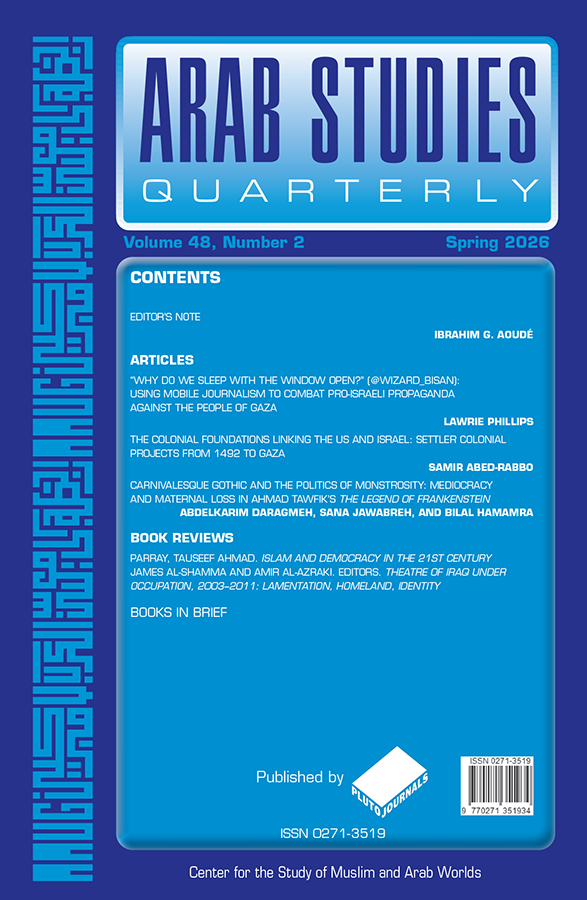 Arab Studies Quarterly (Volume 48, Issue 2), begins with Lawrie Phillips’ article “‘Why Do We Sleep with the Windows Open?’ (@Wizard_bisan): Using Mobile Journalism to Combat Pro-Israeli Propaganda Against the People of Gaza”. The article bases itself on Edward Said’s critique of Orientalism and the Frankfurt School to examine the role of mobile journalism in reporting on the horrendous and devastating impacts of the Zionist entity’s genocide in Gaza.
Samir Abed-Rabbo’s article “The Colonial Foundations Linking the US and Israel: Settler Colonial Projects from 1492 to Gaza” argues that the symbiotic relationship between the Zionist entity in Palestine and the US is based on their shared settler colonial past. The author contends that a re-examination of the US relationship with the Zionist entity would require asking “the critical question of whether a settler empire, still reckoning with its own injustices, can serve as an honest broker for justice abroad”.
Abdelkarim Daragmeh, Sana Jawabreh, and Bilal Hamamra’s article “Carnivalesque Gothic and the Politics of Monstrosity: Mediocracy and Maternal Loss in Ahmad Tawfik’s The Legend of Frankenstein” analyses the way in which Ahmad Tawfik’s novel succeeds in adapting Mary Shelley’s Gothic classic by transforming the monstrous to a “metaphor” for alienation and loss currently experienced by the Egyptian youth.
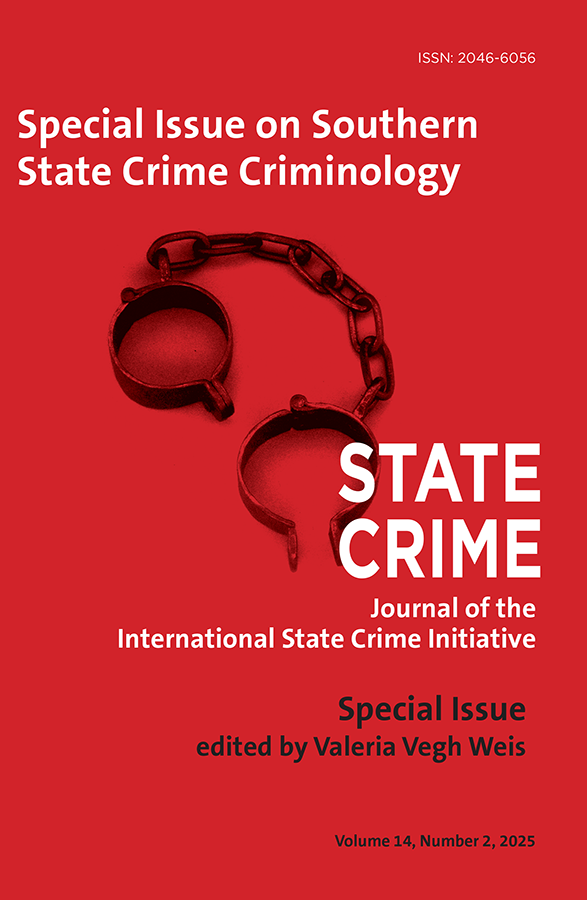 Guest Editor Valeria Vegh Weis introduces this special issue of State Crime (Volume 14, Issue 2) “Introduction: Southern State Crime Criminology”. Drawing on extensive existing literature and promoting a decolonial approach to the study of state crimes, this special issue was created in order to lay the foundations for Global Southern State Crime Criminology.
Aitor Jiménez and Laura Bedford’s article “The Imperial Extractivist Boomerang: The Spectre of (Un)just Transition in Spain” focuses on the San José lithium-mining project in Extremadura, Spain. It highlights the discrepancy between the EU’s proclaimed democratic and environmental values and the reality on the ground. In ““All-Out Against the Mafias.” Optics-Based Governance of the Security Issue in the Cambiemos Administration in Argentina (2015–19)” Pilar Fiuza Casais investigates the electoral victory of the right-wing political party Cambiemos in 2015, examining how this administration characterised “mafias” as a security issue.
Roxana Pessoa Cavalcanti and Guilherme Figueredo Benzaquen’s study “The Criminalization of Social Movements during the Bolsonaro Government (2019–22): State-Centered Perspectives on Crimes of the State” reveals how criminalisation was used as a strategic tool to demobilise social movements through legal proceedings, state surveillance, and police repression. In “Persons, Institution, and Space: For a Legal-Descriptive Framework of State Violence Based on the Carandiru Massacre”, Maira Rocha Machado, Carolina Cutrupi Ferreira, Luisa Moraes Abreu Ferreira, Luisa Mozetic Plastino, Maria Cecília de Araujo Asperti and Viviane Balbuglio study a police operation in a São Paulo prison that resulted in the deaths of at least 111 inmates and left countless others with physical and psychological injuries.
Irnasya Shafira Hadi introduces the concept of criminogenic silence in “Criminogenic Silence: Rethinking Structural Indifference as a State Crime by Omission in Indonesia’s Digital Governance Crisis”. This article contributes to Southern Criminology by foregrounding the normalisation of digital harm as a form of structural social harm in the Global South. Ignasi Bernat analyses the oil spill caused by Spanish company Repsol on the Peruvian coast, and provides a detailed study of countries involved in colonial crimes in “State–Corporate Crime and Southern Criminology: Towards a Colonial Regime of Permission”.Finally, Nicolás Dallorso analyses the Argentinian agri-food sector in “State–Corporate Criminality in the Agri-Food Sector: Challenges to its Regulation in a Semi-Peripheral Country”, arguing that corporate responsibility, and in particular state–corporate criminality, has been overlooked.