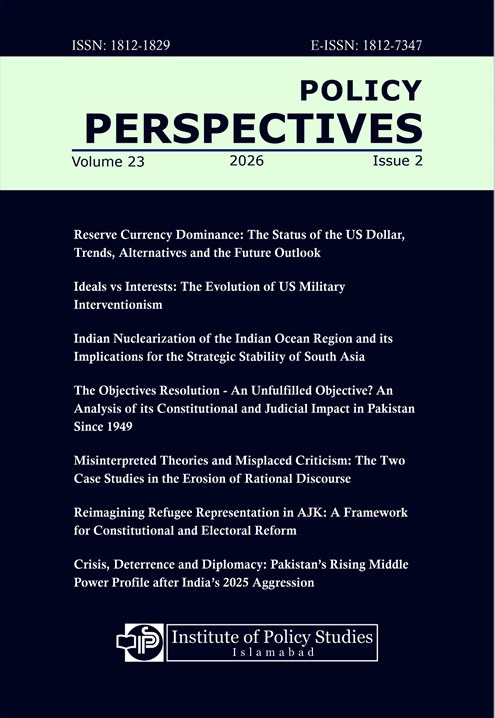
 Policy Perspectives (Volume 23, Issue 2), begins with Shaikh Amjad Maqsood’s article “Reserve Currency Dominance: The Status of the US Dollar, Trends, Alternatives and the Future Outlook”, which explores the historical evolution of international reserve currencies and critically evaluates the evolving international role of the Chinese renminbi and other emerging alternatives, including gold and digital monetary innovations.
In “Ideals vs Interests: The Evolution of US Military Interventionism”, Malik Waleed maintains that while the United States (US) was founded on the principles of liberty, human rights and self-determination, its military interventions across years reflect strategic interests that contradict its founding ideals.
Waleed seeks to understand what constitutes the reasons behind the persistence of such contradictions. In “Indian Nuclearization of the Indian Ocean Region and its Implications for the Strategic Stability of South Asia”, Anwarul Haq appraises the Indian naval nuclear modernisation through the lens of offensive realism and cautions that India’s naval nuclear posture, while increasing the risk of inadvertent escalation, could transform the region into a theatre of the global “Great Game”. In “The Objectives Resolution – An Unfulfilled Objective? An Analysis of Its Constitutional and Judicial Impact in Pakistan Since 1949”, Syed Muaz Shah seeks to examine the true constitutional importance of the Objectives Resolution, its influence on the jurisprudence of Pakistan’s courts, and its continuing relevance to future constitutional debates and developments in Pakistan. Farhat Taj navigates the challenges to scientific discourse in Pashtun academic and cultural contexts in Pakistan in “Misinterpreted Theories and Misplaced Criticism: The Two Case Studies in the Erosion of Rational Discourse”, and provides some insights into how scientific dialogue can be constrained by geopolitical, linguistic, and cultural factors. In “Reimagining Refugee Representation in AJK: A Framework for Constitutional and Electoral Reform”, Iftikhar Gilani assesses alternative options to ensure refugee representation within the Azad Jammu and Kashmir (AJK) legislative framework without undermining the political rights of local people in AJK. Finally, in “Crisis, Deterrence and Diplomacy: Pakistan’s Rising Middle Power Profile after India’s 2025 Aggression”, Waleed Rasool analyses how India’s May 2025 military aggression, named as “Operation Sindoor”, became a strategic catalyst that elevated Pakistan’s geopolitical profile and consolidated its emergence as an emerging middle power despite clear asymmetry in conventional military and economic capabilities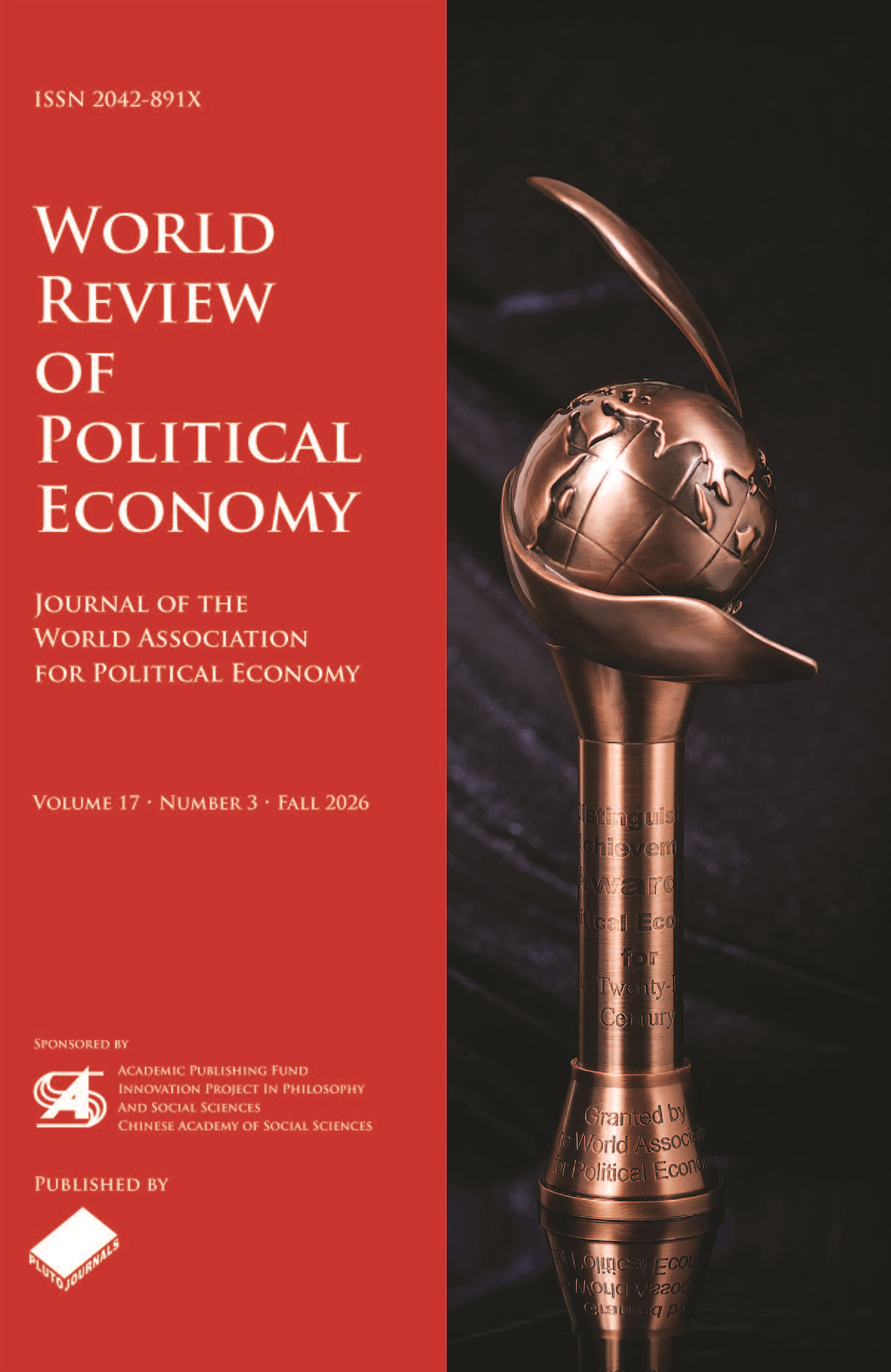 In the latest issue of World Review of Political Economy (Volume 17, Issue 3), Constantinos Alexiou develops a Marxian framework for analysing Artificial Intelligence (AI) as a qualitative transformation of the means of production into an intangible, algorithmic form in “Artificial Intelligence and the Surplus Class: A Critical Analysis of Labour and Automation”. The article critically examines responses and argues that AI creates a political choice between intensified inequality and automated precarity, or a post-capitalist reorganisation of algorithmic means of production towards a collectively owned common. In “The Dollar, Financial Drain and the US Empire—A Comparative Look at the Role of the Dollar Reserve System in Today’s Imperialism”, Ananya Kumar
examines the US dollar reserve system as a central mechanism of contemporary imperialism, comparing US financial dominance with earlier Dutch and British hegemonies. The article estimates that India lost approximately 0.6% of GDP through this mechanism in 2023, equivalent to around one-third of its health budget and concludes that a more democratic international payments system could strengthen Global South sovereignty and promote more equitable development.
In “Beyond the Market: Re-anchoring the Discussion on Socialist Planning in the Marxist Foundations”, Christos Balomenos argues that contemporary debates on socialist planning should be re-anchored in the integrated economic and political analysis of Marx, Engels and Lenin. Maxi Nieto presents a Marxist critique of the degrowth proposal in “The “Degrowth” Proposal: A Reactionary Chimera”, and argues that a progressive ecological transition depends on economic planning and the development of cyber-communism as a framework for coordinating production, technology and environmental sustainability. In “Training Students or Producing a Cheap Labour Force?—A Critical Political Economy of Türkiye’s Vocational Training Centres”, Zelal Beyaz Karçal critically examines Türkiye’s vocational training centres (VTCs) as an institutional expression of the country’s neoliberal labour regime and dependent, labour-intensive capitalist structure. Sungur Savran and E. Ahmet Tonak reviews and assesses the recent Princeton translation of Marx’s Capital, Volume I, edited by Paul Reitter and Paul North in “Against Laying Marx’s Capital Gently on Its Deathbed: Review of the Princeton Translation of Marx’s Capital”.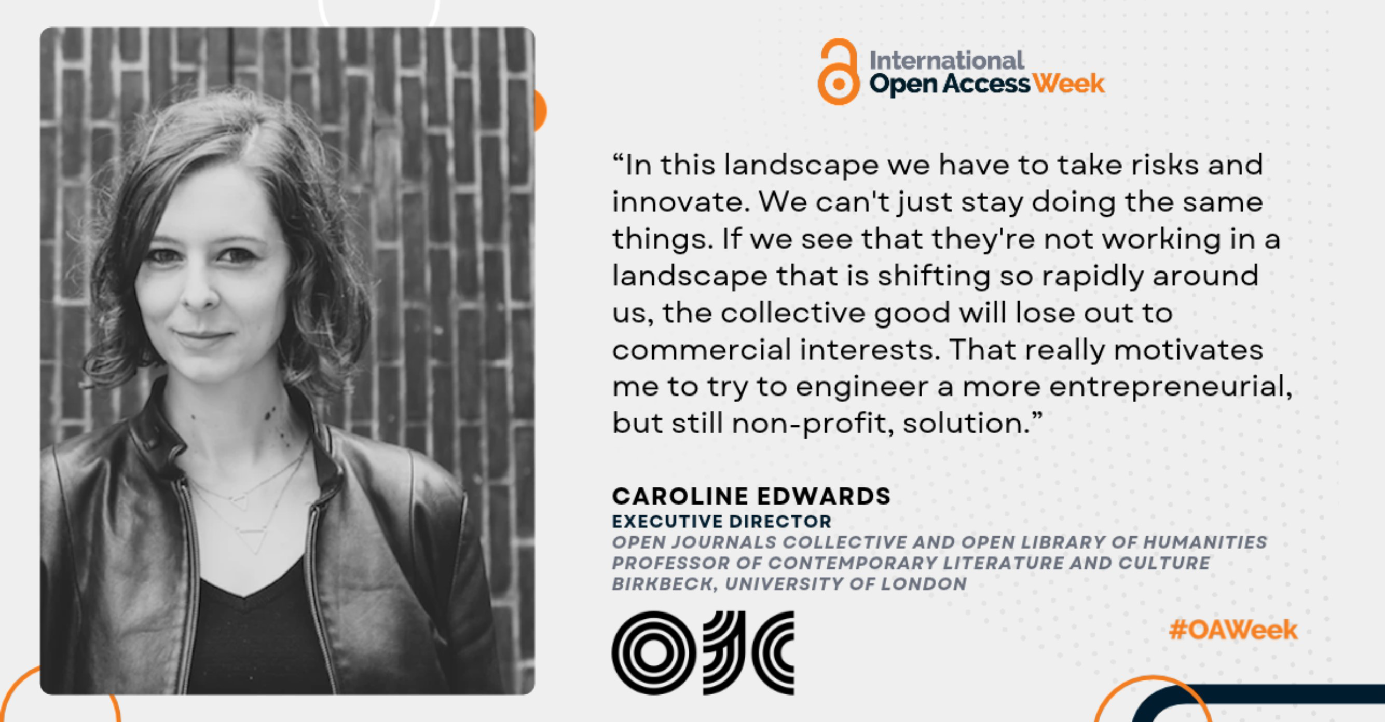 Last month we celebrated Open Access week which explored the theme “the Cost of Knowledge”. In 2026 we joined the Open Journal Collective, which is an initiative set up to build a sustainable future for academic journals by challenging the profit-making models of global corporate publishing and data systems. We wanted to share this post by Caroline Edwards which considers the true cost of academic publishing and why collective investment is so important in keeping research freely accessible to everyone.