
 In ReOrient (Volume 10, Issue 2), Hizer Mir and Sahar Ghumkhor have edited this special issue that explores the many manifestation of the Muslim Manosphere, following the success of their 2022 article “A Crisis of Masculinity? The West’s Culture Wars in the Emerging Muslim Manosphere”. The article attracted considerable interest from both the English-speaking and non-English-speaking worlds and is the second most-read article in the journal’s history, reflecting growing academic and public interest in the topic. The issue opens with Sahar Ghumkhor and Hizer Mir revisiting “Muslims in the Manosphere” and introducing the compelling collection of articles.
In “Conversion as Transgression? Islamophilia and/in the Muslim Manosphere”, Mir and Ghumkhor examine the phenomenon of Islamophilia, the admiration of Islam, that has emerged in the contemporary far right and its manosphere elements. Anila Daulatzai interrogates the work of the Taliban in “Fanboying the Taliban: Manospheric Misogyny and the Project of Whiteness”. Daulatzai reveals the ways liberalism and white supremacy work in lockstep to consolidate the performative force of the Taliban, as simultaneously a spectral Muslim threat for liberals and as white aspiration for white nationalists.
In “The Alt-Good Muslim and the Performance of Anti-Liberalism”, Yassir Morsi examines Texan blogger Daniel Haqiqatjou’s anti-liberal rhetoric, positioning him within the “Muslim manosphere” and the performative outrage that characterises its online presence. In “Islamising the Culture War: Race, Gender, and the Akhi-Right in the Muslim Manosphere”, Shareef Muhammad considers the connections between gender politics, race, and imperial governance. The interview offers a cautionary intervention against naive culture-war alignments and calls for a historically grounded, politically literate Muslim public discourse attentive to power, race, and state violence.
In ReOrient (Volume 10, Issue 2), Hizer Mir and Sahar Ghumkhor have edited this special issue that explores the many manifestation of the Muslim Manosphere, following the success of their 2022 article “A Crisis of Masculinity? The West’s Culture Wars in the Emerging Muslim Manosphere”. The article attracted considerable interest from both the English-speaking and non-English-speaking worlds and is the second most-read article in the journal’s history, reflecting growing academic and public interest in the topic. The issue opens with Sahar Ghumkhor and Hizer Mir revisiting “Muslims in the Manosphere” and introducing the compelling collection of articles.
In “Conversion as Transgression? Islamophilia and/in the Muslim Manosphere”, Mir and Ghumkhor examine the phenomenon of Islamophilia, the admiration of Islam, that has emerged in the contemporary far right and its manosphere elements. Anila Daulatzai interrogates the work of the Taliban in “Fanboying the Taliban: Manospheric Misogyny and the Project of Whiteness”. Daulatzai reveals the ways liberalism and white supremacy work in lockstep to consolidate the performative force of the Taliban, as simultaneously a spectral Muslim threat for liberals and as white aspiration for white nationalists.
In “The Alt-Good Muslim and the Performance of Anti-Liberalism”, Yassir Morsi examines Texan blogger Daniel Haqiqatjou’s anti-liberal rhetoric, positioning him within the “Muslim manosphere” and the performative outrage that characterises its online presence. In “Islamising the Culture War: Race, Gender, and the Akhi-Right in the Muslim Manosphere”, Shareef Muhammad considers the connections between gender politics, race, and imperial governance. The interview offers a cautionary intervention against naive culture-war alignments and calls for a historically grounded, politically literate Muslim public discourse attentive to power, race, and state violence.
William Bayylo investigates “The Muslim Manosphere: A Symptom of the Breakdown of the Socio-Spiritual Ummahtic Fabric”. Finally, in “The Muslim Manosphere and the Discourse of the Capitalist”, Hussein A. Mohamud explores the “Alt-Wallah”, a figure within the emerging Muslim manosphere, through the lens of Lacan’s discourse of the capitalist. They argue that the “Alt-Wallah” functions as a worker-consumer within an ideological economy dominated by far-right masculinist discourse.
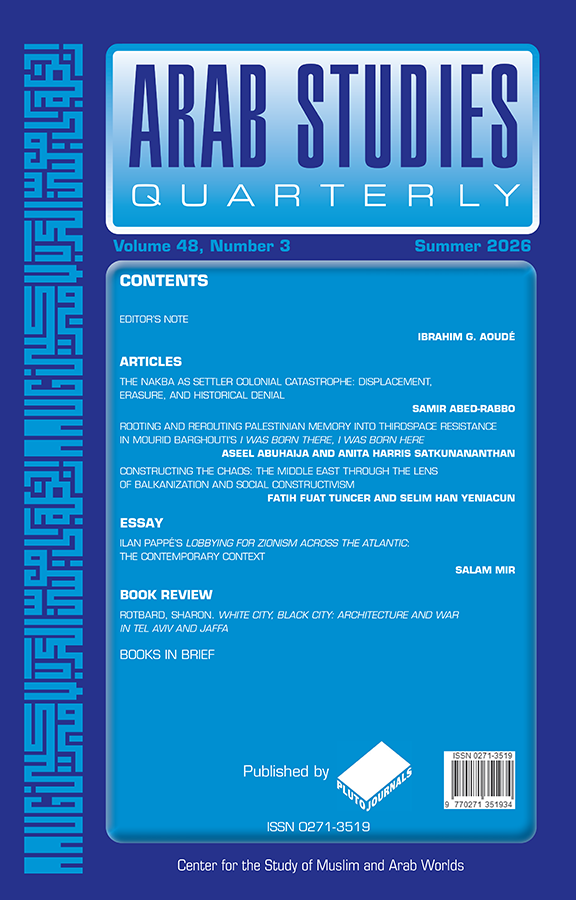 In Arab Studies Quarterly (Volume 48, Issue 3), Ibrahim G. Aoudé introduces the issue’s three articles in his Editor’s Note. Samir Abed-Rabbo’s “The Nakba as Settler Colonial Catastrophe: Displacement, Erasure, and Historical Denial” analyses the Palestinian struggle for return to their homeland. In doing so, Palestinians directly confront Zionist propaganda and narratives of “national restoration” through their steadfastness and the pursuit of the right to RETURN, as a remedy to injustice.
Aseel Abuhaija and Anita Harris Sathkunanan’s article “Rooting and Rerouting Palestinian Memory into Thirdspace Resistance in Mourid Barghouti’s I was Born There, I was born Here” “rethinks” Mourid Barghouti’s first chapter by showing how the dialectic of rooting and rerouting has a deep impact on Palestinian memory. The authors demonstrate this complicated dynamic through Soja’s concept of “Thirdspace Resistance”.
Fatih Fuat Tuncer and Selim Han Yeniacun’s article “Constructing Chaos: The Middle East through the Lens of Balkanization and Social Constructivism”, discusses the way in which internal and external elements have shaped diverse ethnicities, sects, and religions. The concepts of Balkanisation and Constructivist theory that the authors utilise, provide a better understanding of the dynamic nature of the concept of regional identity. In his essay “Ilan Pappé’s lobbying for zionism across the Atlantic: the contemporary context“, Salam Mir notes at the time of writing in April 2026, the Israel–U.S. war against Iran had reached its sixth week. He highlights concerns raised by Jeffrey Sachs and others that continued escalation could lead to a global crisis. Mir also cites Sachs’s argument that Israeli Prime Minister Benjamin Netanyahu had “sweet- talked” U.S. President Donald Trump into launching the war against Iran, for which Netanyahu had been planning for 40 years.