
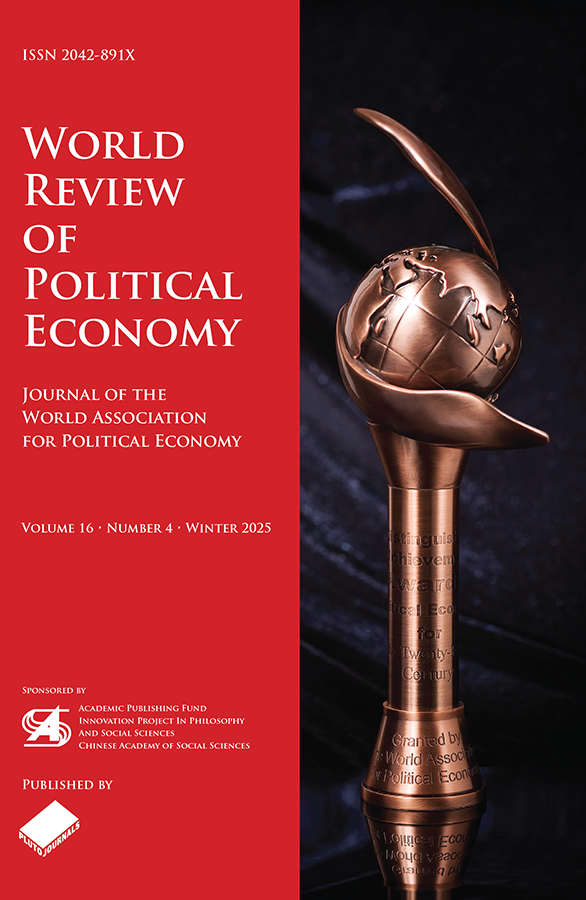
 The World Review of Political Economy, (Volume 16, Issue 4), opens with “On the Law of Slow Growth under Capitalist Private Ownership”, by Enfu Cheng, Libing Sun and Wenbin Xu. The article explores how even when unfavourable factors are excluded, capitalist economies such as the United States, the United Kingdom, Japan, and India have historically grown more slowly than socialist economies like China and the former Soviet Union. In “Revisiting the Estimations of the Rate of Profit for the US Economy: Does the Measure of Gross Capital Stock Matter?” Dimitris Paitaridis and Lefteris Tsoulfidis, argue that employing gross capital stock, rather than the net stock reported by the Bureau of Economic Analysis (BEA), provides a more accurate measure of the available capital. In Carlos Alberto Duque Garcia applies Marx’s insights on foreign trade to examine “Terms of Trade and the Rate of Profit in South America, 1962–2019: A Marxist Political Economy Approach”.
In “Why the Textbook Theory of Price Needs to Be Scrapped”, Howard Nicholas and Bram Nicholas, argue that the failure of the Modern Quantity Theory of Money (MQTM) to adequately explain the aggregate price level stems from its reliance on neoclassical price theory. In “Devouring Mainstream Economics: Oskar Lange’s War Strategy to (Def)eat Bourgeois Political Economy”, Tiago Camarinha Lopes and Lucas Henrique Campos Marin, present what they call “Langean Anthropophagy”. They argue that Lange’s unfinished masterpiece Political Economy is framed by a creative method of engaging critically with bourgeois economic thought following the marginalist revolution, a method that has not yet been fully appreciated. Finally, this issue closes with an introduction to Fred Moseley’s recent book “Introduction to Marx’s Theory of Value in Chapter 1 of Capital : A Critique of Heinrich’s Value-Form Interpretation”.
 Events: World Association of Political Economy annual forum. August, 2026.
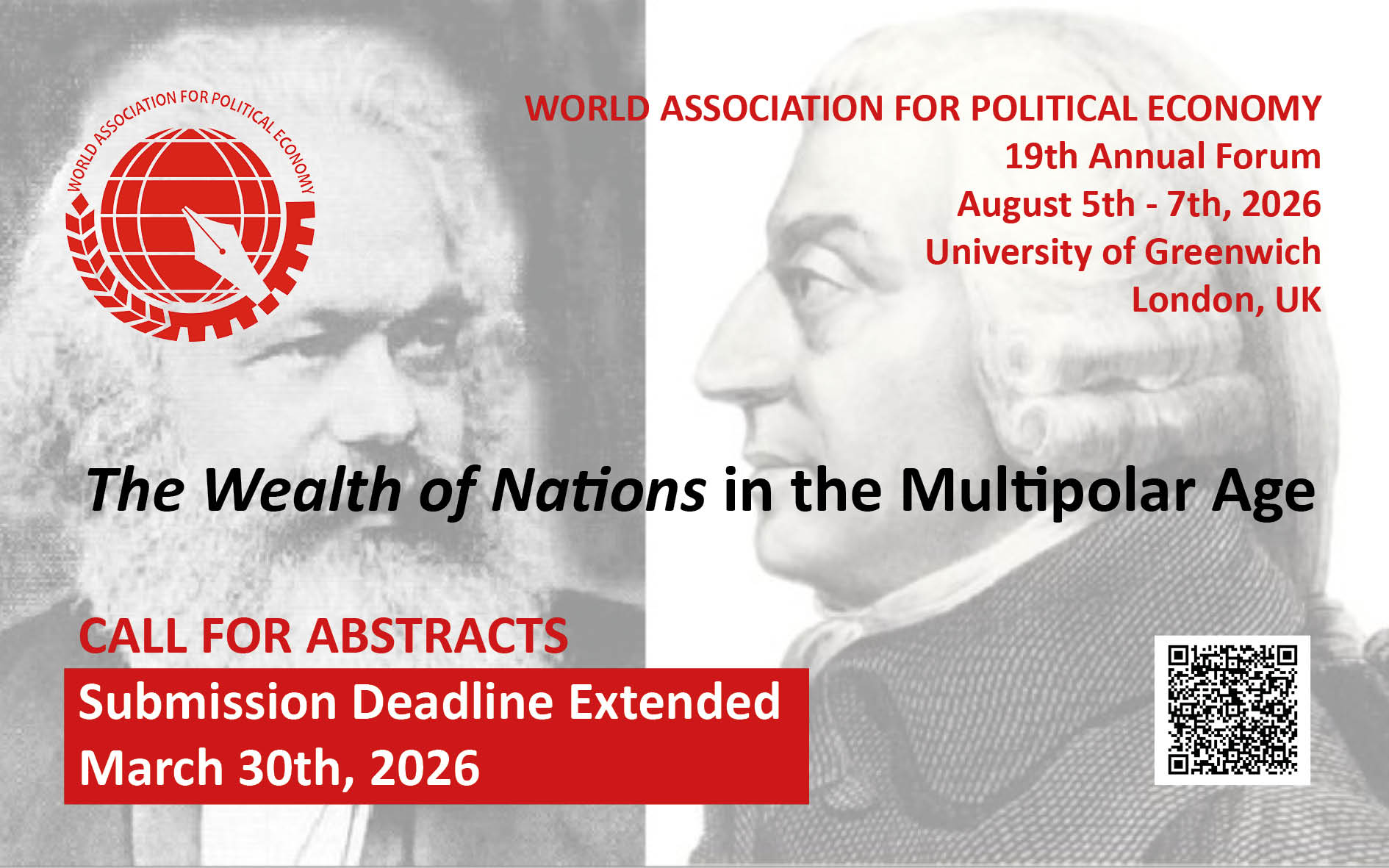
The World Association of Political Economy is holding its annual forum from 5th – 7th August in University of Greenwich on the theme “The Wealth of Nations in the Multipolar Age”, marking the 250th anniversary of the publication of Adam Smith’s The Wealth of Nations. Call for Papers. Abstract deadline 30th March 2026. Read more about Submission & key dates here.
Events: World Association of Political Economy annual forum. August, 2026.
The World Association of Political Economy is holding its annual forum from 5th – 7th August in University of Greenwich on the theme “The Wealth of Nations in the Multipolar Age”, marking the 250th anniversary of the publication of Adam Smith’s The Wealth of Nations. Call for Papers. Abstract deadline 30th March 2026. Read more about Submission & key dates here. 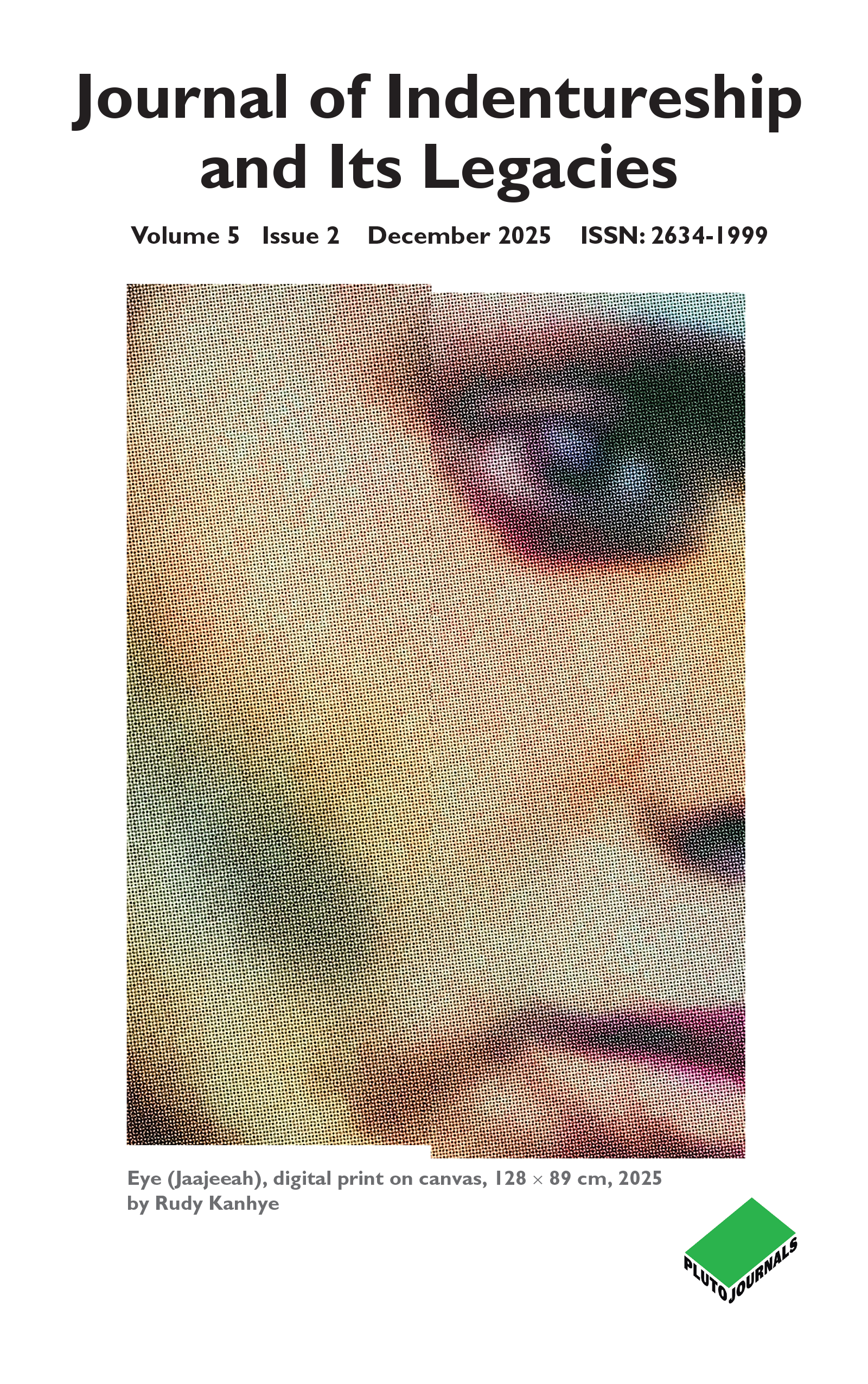 The Journal of Indentureship and Its Legacies, (Volume 5, Issue 2), opens with Juanita Cox’s interview with acclaimed Trinidadian novelist Celeste Mohammed: “Dr Juanita Cox in Conversation with Celeste Mohammed : Ever Since We Small UK Book Tour, 27 October 2025, Tseng Tee Lee Centre, Senate House Library, London”.
Lomarsh Roopnarine considers the little known indenture voyage to St Croix in “The lives of two Indians during indenture in Danish St Croix and British Guiana”. Mark Tumbridge examines one of the earliest novels about the indenture system in the Caribbean in “‘Structures of Ornament’ and Representation in A. R. F. Webber’s Those That Be in Bondage: A Tale of Indian Indentures and Sunlit Western Waters”.
This issue also features a conversation between Sohni Chakrabarti and French-born artist Rudy Kanhye, exploring the erasure of the indenture system in the UK and the idea of gastropoetics in relation to the indentured labour diaspora: “Archiving a different kind of diaspora: A conversation with Rudy Kanhye”. Finally Heidi Safia Mirza reviews “The Lost Love Songs of Boysie Singh by Ingrid Persaud”, and Matt Broadway-Horner reviews “An Ordinary Landscape of Violence: Women Loving Women in Guyana by Preity R. Kumar”.
The Journal of Indentureship and Its Legacies, (Volume 5, Issue 2), opens with Juanita Cox’s interview with acclaimed Trinidadian novelist Celeste Mohammed: “Dr Juanita Cox in Conversation with Celeste Mohammed : Ever Since We Small UK Book Tour, 27 October 2025, Tseng Tee Lee Centre, Senate House Library, London”.
Lomarsh Roopnarine considers the little known indenture voyage to St Croix in “The lives of two Indians during indenture in Danish St Croix and British Guiana”. Mark Tumbridge examines one of the earliest novels about the indenture system in the Caribbean in “‘Structures of Ornament’ and Representation in A. R. F. Webber’s Those That Be in Bondage: A Tale of Indian Indentures and Sunlit Western Waters”.
This issue also features a conversation between Sohni Chakrabarti and French-born artist Rudy Kanhye, exploring the erasure of the indenture system in the UK and the idea of gastropoetics in relation to the indentured labour diaspora: “Archiving a different kind of diaspora: A conversation with Rudy Kanhye”. Finally Heidi Safia Mirza reviews “The Lost Love Songs of Boysie Singh by Ingrid Persaud”, and Matt Broadway-Horner reviews “An Ordinary Landscape of Violence: Women Loving Women in Guyana by Preity R. Kumar”.  This special issue Work Organisation, Labour & Globalisation, (Volume 20, Issue 1), focuses on domestic work as a continuum shaped by hierarchies of class, gender, race and citizenship.
It includes studies of workers including nannies, cleaners, platform-based care workers, transnational wives and butlers from around the world. Revealing the active agency of these usually hidden workers, it also illustrates how they are organising and resisting.
These ten articles comprise this special issue:
“A multi- scalar continuum of domesticities: Social and spatial hierarchies” by Sebastien Chauvin, Claire Cosquer and Julien Debonneville.
“Techniques of non-personship: How butlers maintain social distance while serving elites in physical proximity” by Bryan Boyle.
“Beyond victimhood: The agency of migrant domestic workers during the_COVID- 19 pandemic” by Myrian Carbajal, Emma Gauttier, Christina Mittmasser and Milena Chimienti.
“Domestic work in a gendered moral economy of reciprocity: Gift , counter- gift and sacrifice in Filipino/Thai- Belgian couples in Belgium” by Asuncion Fresnoza- Flot.
“The battle of the squares: When domestic workers protest” by Caroline Ibos.
“More of the same or one step further? A comparative analysis of work on digital home care platforms in Belgium and Spain” by Sofía Pérez de Guzmán, Isabel_María Barrero, Anastasia Joukovsky and Meike Brodersen.
“Same same but different: Care labour migration in China and Singapore” by Lynn_Yu_Ling Ng and Yunhui Ye.
“Between domestic and professional: Ambiguities of the migrant carer position in the private household” by Marija Šaric.
“Constructing better exchanges by enforcing a moral contract: Grey work, irregular migrant labour and the moral economy of illegality in paid domestic work in Geneva” by Loïc Pignolo.
“Outsourcing to mitigate domestic work relations: A case study of French home childcare agencies” by Hélène Malarmey.