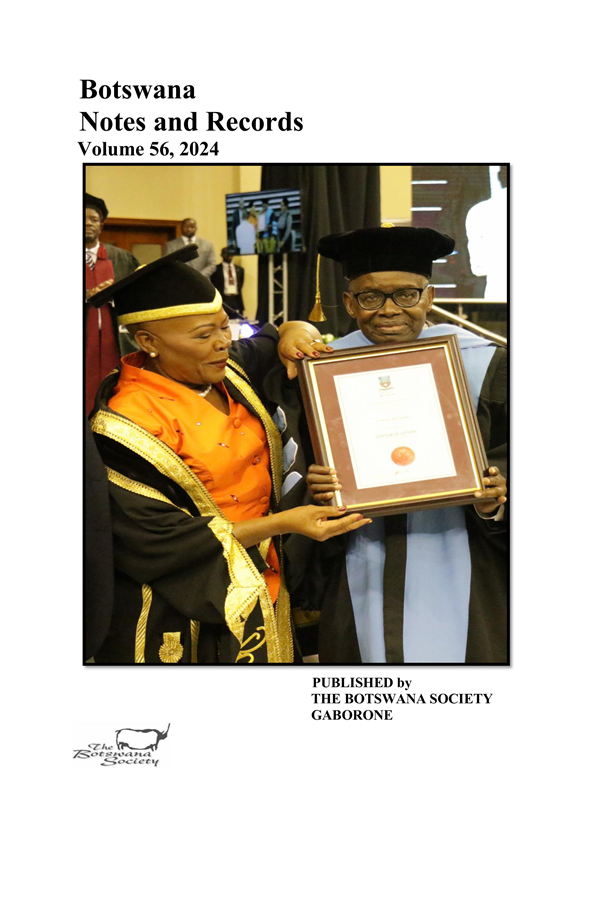
Botswana Notes and Records
Botswana Notes and Records (BRN) is an international, biannual, peer-reviewed diamond open-access journal publishing rigorous scholarship on Botswana’s history, contemporary affairs, languages, folklore, archaeology, biological and natural sciences, and traditional culture. Founded in 1968 by The Botswana Society, BNR provides a forum for researchers and lay contributors, fostering specialised knowledge about Botswana while serving as the preeminent resource for Botswana-focused research.
Print ISSN: 0525-5090
Online ISSN: 2709-7374
Botswana Notes and Records (BNR) is an international, biannual, peer-reviewed diamond open-access journal publishing rigorous scholarship on Botswana. Founded in 1968 by The Botswana Society, a Botswana-based non-governmental organisation, the journal emerged as a collaboration of scholars, civil servants, and lay enthusiasts dedicated to building knowledge about the newly independent nation.
The journal’s mission remains “to make Botswana better known to itself and the world.” BNR stands as the only journal devoted entirely to Botswana, publishing multidisciplinary research on history, contemporary affairs, languages, folklore, archaeology, biological sciences, and traditional culture.
BNR publishes peer-reviewed articles, a distinctive “Notes” section featuring memoirs, biographies, and primary source materials, and book reviews of Botswana-related publications. The journal welcomes contributions from international scholars and lay persons, creating a unique forum accessible to both academic researchers and general readers.
Formerly published in print through 2012, BNR is now published by Pluto Journals in partnership with African Books Collective and The Botswana Society, hosted on ScienceOpen’s Diamond Open Access platform.
Botswana Notes and Records creates a forum for rigorous, creative research reflecting the multidisciplinary nature of Botswana studies. The journal welcomes scholarship examining Botswana’s history, contemporary political and social affairs, languages, folklore, archaeology, biological and natural sciences, traditional culture, and related topics. BNR encourages diverse methodological approaches and perspectives, publishing articles from internationally recognised scholars alongside contributions from lay persons with specialised knowledge of Botswana. The journal’s distinctive “Notes” section preserves primary source materials valuable for future research, including personal memoirs, biographies, photographs, and reminiscences. BNR also publishes book reviews of Botswana-related publications from regional and international publishers. Through this multidisciplinary approach, the journal fulfils its founding mission to make Botswana better known to itself and the world, supporting education, informing policy, and addressing the continuing need for published literature about this independent nation with its distinctive political, social, and economic record.
Editorial Committee
Chair: Prof. Fred Morton – University of Botswana, Botswana
Editor: Prof. Christian John Makgala – University of Botswana, Botswana
Assistant Editor: Dr. Phuthego Molosiwa – University of Botswana, Botswana
International Advisory Board
Prof. Jacqueline Solway – Trent University, Canada
Prof. Jane Carruthers – University of South Africa, South Africa
Prof. Elize van Eeden – North-West University, South Africa
Prof. Jan-Bart Gewald – University of Leiden, Netherlands
Dr. Ørnulf Gulbrandsen – Bergen University, Norway
Prof. Nancy Jacobs – Brown University, United States
Prof. Julie Livingston – Rutgers University, United States
Prof. Paul Shaw – University of West Indies, Trinidad and Tobago
Dr. Stephen Volz – Kenyon College, United States
Dr. Nick Walker – Independent Scholar, South Africa
Prof. Richard Werbner – Manchester University, United Kingdom
Dr. Amy Poteete – Concordia University, Canada
Prof. Francis Nyamnjoh – University of Cape Town, South Africa
Prof. Ashley Jackson – University of London, United Kingdom
Prof. Paul Landau – University of Maryland, United States
Dr. Bafumiki Mocheregwa – University of Southern Mississippi, United States
Dr. Mark Nyandoro – University of Zimbabwe, Zimbabwe
Dr. Unaludo Sechele – University of the Free State, South Africa
Prof. Neil Parsons – Independent Scholar, United Kingdom
Jorich Johann Loubser – London School of Economics, United Kingdom
Please see the submission guidelines here.
Editor: Prof. Christian John Makgala
University of Botswana, Botswana
Email: makgalacj@ub.ac.bw
Society Information: The Botswana Society, Gaborone, Botswana
Website: https://www.thebotswanasociety.net/
Journal Website: https://journals.ub.bw/index.php/bnr
The journal is published biannually, with plans to expand publication frequency in the future. Founded in 1968 by The Botswana Society, Botswana Notes and Records has appeared without interruption since its first volume, maintaining its fundamental mission as the Society’s organ. Print publication continued through 2012; since 2013, all volumes have been available through the University of Botswana’s Open Journal System. BNR is now published by Pluto Journals in partnership with African Books Collective and The Botswana Society, hosted on ScienceOpen’s open-access platform, expanding its reach to global audiences while maintaining its commitment to diamond open-access publishing.
Botswana Notes and Records is a Diamond Open Access journal publishing under the CC BY 4.0 license https://creativecommons.org/licenses/by/4.0/. There are no Author Publication Fees payable to submit or publish in this journal. With this license users are free to “distribute, remix, tweak, and build upon [the works], even commercially, as long as they credit the authors” who retain copyright of their work with a Creative Commons Attribution (CC-BY 4.0) license as stated here.
This journal follows Pluto Journals’ Ethics and Code of Conduct policy, which aligns with the ethical standards endorsed by the Committee on Publication Ethics (COPE). In particular:
- We expect all authors to state in their article if they have a conflict of interest which could potentially bias their opinions – for example funding or employment.
- All named authors on the articles should confirm that they have jointly participated in the research and writing of the article, and that no author has been omitted from the list of authors.
- We require authors to warrant that their articles are original, have not been previously published, and do not plagiarise or otherwise copy someone else’s work without attribution. (If the article is a translation, we are happy to consider this for publication but the authors must inform the editors on submission).
- We also require authors to warrant that their article does not defame, libel, or bring another person into disrepute, and neither does it contain anything illegal (e.g. copyright infringing).
- Editors and reviewers must disclose any potential conflicts of interest that could influence, or be perceived to influence, their handling of a manuscript. Conflicts may include personal relationships, academic competition or financial interests related to the work under consideration. If a conflict exists, editors and reviewers must decline to participate in the review or editorial decision-making process. The journal maintains procedures to ensure that editorial decisions are made without bias and based solely on scholarly merit. Editors are not involved in decisions about papers in which they have a conflict of interest and such submissions are handled by another qualified editor.
- All submissions are checked for originality during the editorial review. The reviewer’s role includes the process of checking and dealing with text similarity and suspected plagiarism. Plagiarism includes the unattributed use of another author’s words, ideas, data, or images, as well as excessive text recycling from one’s own prior work. Reviewers are responsible for reporting potential misconduct concerns to the Editor, who handles concerns according to the COPE plagiarism flowchart https://members.publicationethics.org/sites/default/files/plagiarism-submitted-manuscript-cope-flowchart.pdf. Manuscripts found to contain significant plagiarism are rejected, and if plagiarism is discovered after publication, the journal may issue a correction or retraction and notify the authors’ institution as appropriate. The editor is responsible for guiding the process and for publishing corrections, retractions or expressions of concern when appropriate. All authors will be informed and their consent (where possible) obtained before any changes are made. Appropriate measures will be taken, including possible retractions of articles, when cases of scholarly misconduct are detected.
- Retraction of articles may be required when there is clear evidence that the findings are unreliable due to misconduct (e.g., data fabrication, plagiarism) or honest error; when the work has been previously published elsewhere without proper attribution; or when the research or publication process was unethical. Retraction notices are published promptly, clearly identified as such and linked to the original article, which remains in the public record but marked as retracted. The notice will include the reasons for retraction and who is retracting the article.
- Corrections (errata or corrigenda) are published by the journal to ensure the accuracy and integrity of the scholarly record. If an error is identified that affects the publication’s reliability, but not its overall conclusions, a correction will be issued. Corrections will clearly describe the change, reference the original article, and be freely accessible. Minor errors that do not affect the interpretation of the work will not typically warrant formal correction.
- Appeals: should an author wish to appeal a decision of Reject, they should write to the Editorial Executive. Two members of the Editorial Board not involved in the original review process for the article will reconsider the article and reviews and to submit their recommendations. Only one round of appeal will be permitted per manuscript.