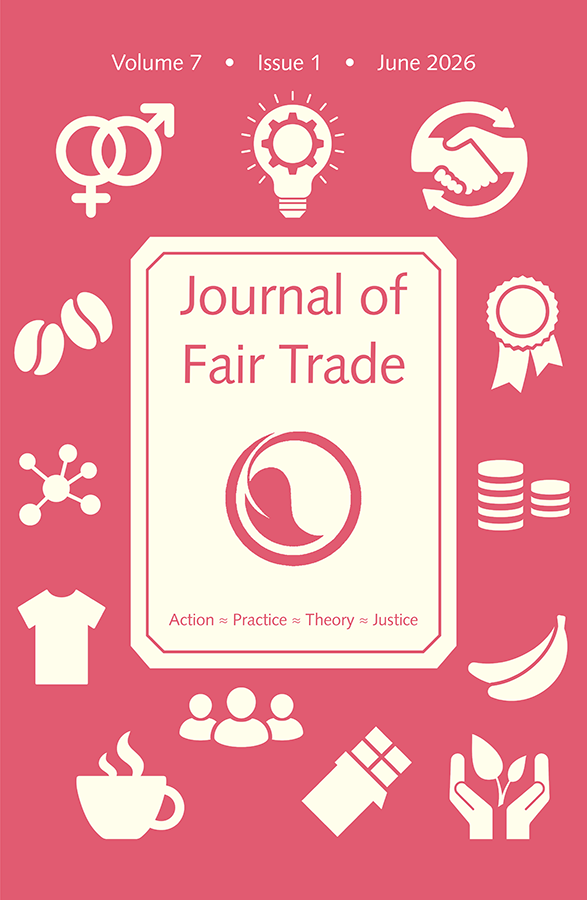
Journal of Fair Trade
The Journal of Fair Trade is a biannual, single-blind, peer-reviewed title. It aims to be a leading source of research on Fair Trade, bringing together the voices of academics and practitioners to reclaim the best practices and values that contribute to mutuality and fairness in trade.
Print ISSN: 2513-9525
Online ISSN: 2513-9533
The Journal of Fair Trade is a new independent, peer-reviewed academic journal launched by the Journal of Fair Trade Society, in February 2019, to reclaim the best practices and values that contribute to mutuality and fairness in trade. The Journal aims to be a source of the leading research on Fair Trade. The Journal of Fair Trade Society website provides a forum and funnel for new work, ideas and debate.
Donate to support the Journal of Fair Trade Society
Your support is vital to supporting the future production of the Journal of Fair Trade. Please donation on Kindlink here.
The Journal provides a much-needed independent space in which to discuss the ever-changing practical and theoretical approaches to making the world a more just place through business and trade. The term ‘Fair Trade’ includes certification systems and all efforts to ensure trade is fair for all. Unafraid to be outspoken, the goal of the Journal is to catalyse significant improvements in the way all types of trade deliver social and environmental justice.
The Journal and the Journal of Fair Trade Society publish independent academic work, briefings and articles. They promote new voices and experiences from cooperatives, producer organisations and practitioners, as well as Fair Trade businesses and corporations striving to be responsible global citizens. The founders of this Journal want to encompass the full range of interests and voices that need to be heard on these issues. For information on how to submit to the Journal, please click here.
Editor-in-Chief
Pauline Tiffen, Editor-in-Chief
Emma Anderson, Journal Manager,
Editorial Board
Professor Robert Doherty, University of York, UK;
Professor Michael Goodman; University of Reading, UK;
Professor Daniel Jaffee, Portland State University, USA;
Dr Patrick Van Zwanenberg, STEPS América Latina / CENIT, Universidad Nacional de San Martin, Argentina and
Dana Geffner, Executive Director, Fair World Project, USA;
Professor Laura Raynolds, Center for Fair & Alternative Trade, Colorado State University, USA;
The Guidelines for Authors are here with details of article types and submission requirements as well as our Open Access Publishing Permissions .
The Journal of Fair Trade welcomes submissions from anyone who wishes to contribute to the debate on the challenges and future of Fair Trade. All contributions will be constructively reviewed in line with the Journal’s single-blind peer review policy.
The Journal of Fair Trade Volume 7 Issue 2, Special Edition: “Livelihoods, Community Resilience & Environmental Regeneration: the role of smallholder organisations, coops & Social Enterprise”.
The Journal of Fair Trade is calling for papers to curate a Special Edition on “Livelihoods, Community Resilience & Environmental Regeneration: the role of smallholder organisations, coops & Social Enterprise”.
Livelihoods, Community Resilience and Environmental Regeneration: the role of smallholder organisations, coops and social enterprises. What is the case for and against the role of farmer coops, social enterprises/third sector organisations in sustainable transformation and mitigating climate change?
There is a growing sense that “projectised social” and environmental interventions are costly and not always ‘durable’. Do SPOs/coops/SME alliances and clusters that acquire skills, infrastructure and community presence and have more longevity or more impact?
The JoFT Society is accepting Submissions now. We welcome producer co-op/social enterprise case studies/experiences as well as theoretical work, critique and evaluation. Guidelines for contributors are available here.
If you have ideas or questions please email Emma Anderson, emma.anderson@joft.org.uk .
Journal’s Editor-in-Chief, Pauline Tiffen, at paulinetiffen@joft.org.uk
Journal Manager, Emma Anderson, emma.anderson@joft.org.uk
Fair Trade Society Membership enquiries membersupport@plutojournals.com
Publisher, Pluto Journals, evek@plutojournals.com
The journal is biannual, published online in approx May and October. The electronic journal is archived in Portico.
The journal is Open Access and the Open Access statement, Open Access license terms, copyright terms as well as a statement on its absolute lack of author charges can be found here.
The journal became Open Access on 1 January 2021 and is published open access on ScienceOpen and JSTOR. All journal material published prior to 1 January 2021 is also published, open access on ScienceOpen and JSTOR. This means the Reuse rights of published material is all under the open CC BY 4.0 license as stated here.
This journal follows Pluto Journals’ Ethics and Code of Conduct policy, which aligns with the ethical standards endorsed by the Committee on Publication Ethics (COPE). In particular:
- We expect all authors to state in their article if they have a conflict of interest which could potentially bias their opinions – for example funding or employment.
- All named authors on the articles should confirm that they have jointly participated in the research and writing of the article, and that no author has been omitted from the list of authors.
- We require authors to warrant that their articles are original, have not been previously published, and do not plagiarise or otherwise copy someone else’s work without attribution. (If the article is a translation, we are happy to consider this for publication but the authors must inform the editors on submission).
- We also require authors to warrant that their article does not defame, libel, or bring another person into disrepute, and neither does it contain anything illegal (e.g. copyright infringing).
Editors and reviewers must disclose any potential conflicts of interest that could influence, or be perceived to influence, their handling of a manuscript. Conflicts may include personal relationships, academic competition, or financial interests related to the work under consideration. If a conflict exists, editors and reviewers must decline to participate in the review or editorial decision-making process. The journal maintains procedures to ensure that editorial decisions are made without bias and based solely on scholarly merit. Editors are not involved in decisions about papers in which they have a conflict of interest and such submissions are handled by another qualified editor.
Retraction of articles may be required when there is clear evidence that the findings are unreliable due to misconduct (e.g., data fabrication, plagiarism) or honest error; when the work has been previously published elsewhere without proper attribution; or when the research or publication process was unethical. Retraction notices are published promptly, clearly identified as such, and linked to the original article, which remains in the public record but marked as retracted. The notice will include the reasons for retraction and who is retracting the article.
Corrections (errata or corrigenda) are published by the journal to ensure the accuracy and integrity of the scholarly record. If an error is identified that affects the publication’s reliability, but not its overall conclusions, a correction will be issued. Corrections will clearly describe the change, reference the original article, and be freely accessible. Minor errors that do not affect the interpretation of the work will not typically warrant formal correction.
All submissions are checked for originality by editorial review. The reviewer’s role involves the process of checking and dealing with text similarity and suspected plagiarism. Plagiarism includes the unattributed use of another author’s words, ideas, data, or images, as well as excessive text recycling from one’s own prior work. Reviewers report potential misconduct concerns to the Editor, who handles concerns according to the COPE plagiarism flowchart https://members.publicationethics.org/sites/default/files/plagiarism-submitted-manuscript-cope-flowchart.pdf. Manuscripts found to contain significant plagiarism are rejected, and if plagiarism is discovered after publication, the journal may issue a correction or retraction and notify the authors’ institution as appropriate. The editor is responsible for guiding the process and for publishing corrections, retractions, or expressions of concern when appropriate. All authors will be informed and their consent (where possible) obtained before any changes are made. Appropriate measures will be taken, including possible retractions of articles, when cases of scholarly misconduct are detected.
Appeals: should an author wish to appeal a decision of Reject, they should write to the Editorial Executive. Two members of the Editorial Board not involved in the original review process for the article will reconsider the article and reviews and submit their recommendations. Only one round of appeal will be permitted per manuscript.